General Secretary Xi Jinping has emphasized that building urban underground pipe networks is a "backstage" project for cities. As the central government explicitly proposes strengthening the planning and construction of the "Six Networks," underground pipe networks—the "lifeline" safeguarding urban operations—are ushering in a new round of construction and renovation.
Hunan has responded swiftly. In 2026, the province plans to build 586 underground pipe network projects in the urban construction sector, with a total investment of nearly 16 billion yuan. The existing water supply, gas, drainage, and sewage pipe networks already exceed 170,000 kilometers in total length, and the demand for renewing and upgrading aging networks is growing day by day.
However, problems caused by aging pipe networks—such as water and gas outages, poor drainage, and repeated road excavation—directly affect people's lives and the safety of urban operations. As a leading local engineering machinery enterprise in Hunan deeply engaged in underground engineering equipment and rail transit equipment, China Railway Construction Heavy Industry Corporation (CRCHI) has, in implementing the national "Six Networks" construction, independently developed core equipment such as hard rock pipe jacking machines, retractable pipe curtain machines, and pipeline renewal boring machines to address prominent issues such as complex geological conditions in urban underground pipe network construction and difficult operations in densely built-up areas.
Zhang Ruilin, manager of the Third Branch of CRCHI's Tunneling Machine Research and Design Institute, introduced that the company has now formed a full-scenario trenchless intelligent equipment and serialized process system covering new pipe network construction, repair, and renewal, providing a "Hunan Solution" for pipe network renewal and renovation through a "minimally invasive surgery"-style construction method.
Pipe Network Renewal Calls for "Trenchless" Methods
Urban underground pipe network renewal and renovation is a key development direction for underground engineering. At present, the pipe network renewal field is undergoing a comprehensive transformation toward mechanization, intelligence, and green development. However, traditional construction methods have prominent shortcomings: underground working spaces are cramped and the environment is harsh, making manual construction risky; desilting and repair mostly rely on manual labor, with low efficiency, long cycles, many safety hazards, and insufficient environmental friendliness—making it difficult to meet modern urban construction standards.
According to deployment plans, Hunan plans to build and renovate 2,200 kilometers of drainage and sewage pipe networks, 1,100 kilometers of gas pipe networks, and 1,000 kilometers of water supply pipe networks this year. In densely built urban areas with interlaced pipelines, busy traffic, and rows of shops, "no excavation, fast construction, minimal disturbance" has become a rigid demand, placing higher requirements on the adaptability of construction equipment.
Traditional excavation construction often means long-term fencing, road surface demolition, noise, and dust. In response to these pain points, CRCHI continues to promote the upgrading of construction equipment, replacing manual work with mechanized operations. Its serialized specialized equipment has been verified in multiple benchmark projects at home and abroad.
Full-Chain Equipment Delivers "Minimally Invasive Surgery"
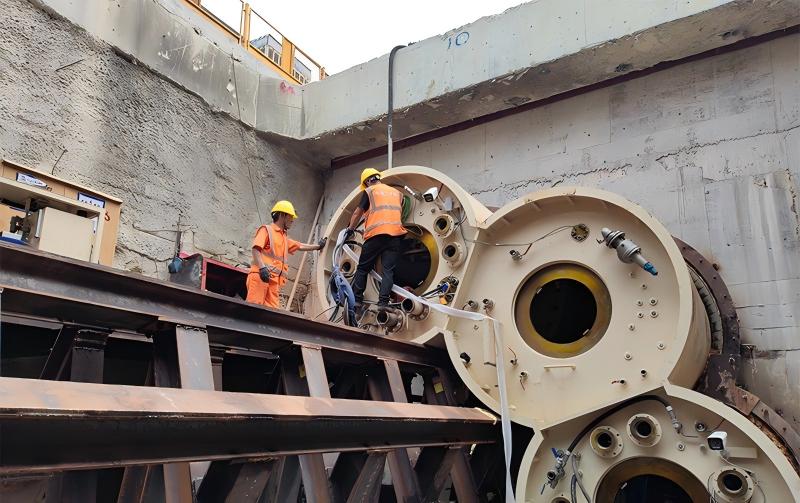
Facing construction challenges in densely built urban areas, CRCHI has formed a serialized matrix of specialized pipe network equipment.
"In simple terms, the old pipe is cut and removed, and the new pipe is jacked in to replace it," Zhang Ruilin explained. For large-diameter pipe networks of DN1000 (nominal diameter 1000 mm) and above, the equipment adopts a modular split structure that can adapt to the narrow working space of conventional urban manholes. It innovatively establishes a "cut—split—discharge—replace" four-in-one intelligent pipe network replacement core process, and currently a single continuous jacking distance can reach more than 100 meters. For small- and medium-diameter pipe networks of DN200–DN1000, CRCHI has developed mature processes including slotting and splitting, extrusion replacement, and synchronous pushing.
"The entire solution greatly reduces road surface demolition and lane occupation, effectively adapting to high-density construction conditions in urban areas," Zhang Ruilin said. This is equivalent to performing "minimally invasive surgery" on underground pipe networks. Under the premise of less disturbance to residents and less excavation, it solves the urban "road zipper" problem and achieves same-diameter repair and capacity expansion and quality improvement of pipelines. Construction fencing time is greatly shortened, significantly reducing the impact on citizens' travel, street-facing businesses, and urban traffic, making pipe network renewal and renovation a genuine livelihood project that is "unseen in disturbance but visible in reassurance."
Benchmark Projects Set New Domestic Records
In the raw water pipeline project of the Changsha Leifeng Water Plant, CRCHI, together with Changsha Water Group, China Construction Fifth Engineering Division, and other units, built the hard rock pipe-shield machine "Chengtwang Chuanyue Hao," which was successfully applied in extremely hard rock strata with a maximum strength of 164 MPa.
The project faced enormous challenges from extremely hard rock construction in urban areas. Traditional pipe jacking equipment has insufficient jacking force and struggles to achieve long-distance, small-curvature tunneling; conventional shield machines require larger launch shafts, facing difficulties in urban areas such as land acquisition, large excavation volumes, and serious disturbance to residents, making it hard to balance safety, efficiency, and economy.
"Chengtwang Chuanyue Hao" integrates the dual advantages of pipe jacking and shielding, with a construction mode that can be flexibly switched and adapted to launch from small working shafts. It overcomes the difficulties of long-distance, small-radius curved pipeline tunneling in extremely hard rock strata and greatly reduces ground excavation and disturbance to the surrounding environment. This "Hunan first" equipment and construction method has outstanding demonstration value and can be replicated and promoted in a large number of urban underground crossing construction scenarios in Hunan and across the country.
In addition to the Changsha Leifeng Water Plant, CRCHI's trenchless equipment has set records in multiple major projects.
In the Yinchoji-Liao Water Diversion Project in Hinggan League, Inner Mongolia, the company applied China's first composite hard rock pipe jacking machine suitable for long-distance extremely complex strata, directly addressing soft-hard interbedded layers of tuff and granite and water-rich, highly permeable geology. It pioneered a complete set of pressurized chamber cutter replacement construction technology in China's pipe jacking field, achieving a maximum daily advance of 15 meters and establishing an engineering paradigm for hard rock jacking in long-distance deep-buried water conveyance tunnels in China.
In the Nangao Main Canal Water Supply Replacement Project for the Kinmen Water Supply Source Guarantee in Fujian, China's first integrated pipe-shield machine for complex strata was deployed, overcoming multiple adverse geological conditions including upper-soft-lower-hard strata, water-rich zones, and silt with sand. It achieved a 300-meter small-radius curve turn and twice crossed beneath the Jinjiang River, verifying the ability of domestically produced integrated pipe-shield equipment to cross complex water bodies in a water supply "lifeline" project.
Overseas, in Thailand's natural gas pipeline direct-lay project, the domestically produced smallest-diameter rapid pipe-laying machine "made its mark abroad," with a single machine completing the full breakthrough of nine sections within one year. It precisely and safely crossed beneath high-voltage power tower pile foundations, setting multiple world records including 1,046 meters of tunneling in a single section and 202 meters per shift at the same pipe diameter level, demonstrating the top strength of China's trenchless equipment in overseas energy projects.
Industrial Cluster Supports CRCHI's Deepened Expansion
From the Changsha Leifeng Water Plant to the Hong Kong Sha Tin Sewage Treatment Works and further to the Thailand natural gas pipeline project, CRCHI's trenchless equipment has moved from Hunan to a broader market. Leveraging Hunan's world-class engineering machinery industrial cluster, CRCHI continues to deepen its presence in the underground pipe network equipment sector, promoting "Hunan Manufacturing" across the country and around the world.
Specifically, on the one hand, CRCHI leverages Hunan's complete industrial chain supporting capabilities to continuously iterate its core trenchless equipment and seize opportunities from the national "Six Networks" construction. On the other hand, it deeply integrates into Hunan's robotics industry development strategy, using the intelligentization and robotization of pipe network equipment as a starting point to complete the full-chain intelligent equipment system for desilting, repair, and replacement, and to drive the company's transformation from a single equipment manufacturer to a provider of integrated "equipment + process + service" solutions. At the same time, it benchmarks against international standards to optimize product performance, builds overseas spare parts and technical service systems, and continuously enhances the international competitiveness of domestically produced pipe network equipment.
During the "15th Five-Year Plan" period, the country is expected to build and renovate more than 770,000 kilometers of underground pipe networks, with investment of about 5 trillion yuan over the next five years. Hunan is actively soliciting application scenarios for "Six Networks" construction and promoting the accelerated implementation of intelligent monitoring of underground pipe networks and risk early warning for urban lifelines.
Zhang Ruilin stated that CRCHI will implement the national "Six Networks" strategy, comprehensively upgrade its pipe network industry layout around three major areas—intelligent R&D, production capacity reserves, and overseas expansion—deepen coordination with local industrial and supply chains, and achieve large-scale, standardized, and efficient production. It will replicate the experience of benchmark projects such as the Thailand natural gas pipeline and Hong Kong sewage treatment, and export complete sets of trenchless intelligent equipment, construction processes, and integrated solutions to markets at home and abroad.
From "cutting open the belly" to "minimally invasive surgery," from single-point equipment to full-chain solutions, Hunan is using leading enterprises such as CRCHI as a fulcrum and relying on the advantages of its engineering machinery industrial cluster to provide replicable and promotable trenchless intelligent equipment solutions for the "Six Networks" construction. This is not only a new track for "Hunan Manufacturing" but also new support for the safe, green, and efficient construction of urban underground pipe networks. It is also a pragmatic answer to serving urban livelihoods through industrial strength and safeguarding the "lifeline" of urban operations.
Source: Rednet
XCMG XR240E "Tackles" Challenging Working Conditions!
下一篇Taixin KR200D Intelligent Power Construction Drilling Rig Supports National Key Energy Project Construction

2026-09-28 1157 0

2026-09-24 10586 0

2026-09-23 10714 0

2026-09-22 10808 0

Lize City Air Terminal Underground Main Structure Nearing Completion: Maximum Transfer Walk Under 4 Minutes After Operation

Anti-seepage Curtain for Main Lock Pit of CSCEC Port Shenqiu Double-Line Lock Project Completed on Schedule

All Pile Foundations Completed on Quanzhou Baiqi Channel

Hainan Upgrades Housing and Municipal Infrastructure

First Foundation Concrete Pour Successfully Completed for Zambia Kafue West–Muzuma 330kV Transmission Line EPC Project
Hot News

评论 (0)