"The mountains at Shanda are full of rocks, and you have to climb slopes as soon as you step out the door; the soil is all hidden in the crevices between the rocks, so you plant a whole hillside and harvest only a basketful." In Xuan'en, Hubei, a local jingle like this circulates, precisely capturing the reality of the complex terrain of the Wuling Mountain area and the inconvenience it brings to residents' travel and industrial development. Even though the local government built a section of National Highway 209 that runs through the city, freight trucks, passenger vehicles, and residents' travel are all mixed together, causing not only traffic congestion but also safety hazards. Therefore, building a bridge that can divert large transit vehicles and free up urban traffic space has long been the hope of local residents.
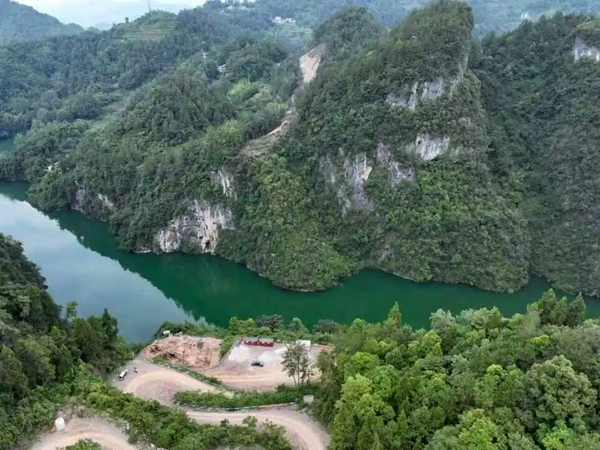
In response to the needs of the people, the Xuan'en Bridge on National Highway 209, undertaken by CCCC First Harbor Engineering Co., Ltd., officially started construction. This 708-meter cable-stayed bridge will span a composite karst landscape formed by the interweaving of stone forests, karst caves, and gorges, creating a new transportation artery for the people of Xuan'en.
"The rock mass in the construction area is hard and highly resistant. What is even more troublesome is that there are as many as hundreds of underground karst caves, which develop in connected strings over a continuous area. Driving piles into this is like standing chopsticks on a honeycomb: you have to break through the outer shell to 'insert' them, and also avoid the cavities so they 'stand' firmly." Although they had anticipated the complex terrain, Project Chief Engineer Jiang Liqiang and the project team still felt enormous pressure when they saw the crisscrossing hard limestone and the dense, irregularly distributed cave clusters, like holes in a sieve.
"First, we have to solve the problem of 'inserting.' If the pile holes cannot be drilled, all subsequent work is empty talk." Facing the challenge of interlocking hard limestone, Jiang Liqiang and the project team did not back down. Instead, they decided to "fight hardness with hardness" and selected the percussion drilling method for hole formation. Compared with the rotary drilling method, the percussion drilling method is more like a "heavy hammer," able to rely on the powerful impact energy released by the free fall of the percussion hammer head to break through hard rock layers and lay a solid foundation for the bridge pile foundation construction.
Although the problem of "being able to insert" was solved, the "fighting hardness with hardness" approach proved helpless when faced with the underground string-connected caves. It turned out that the karst caves developing in connected strings over a continuous area formed an intricate "underground maze." After the drill bit penetrated the rock layer, the mud originally used to maintain the pile foundation wall protection and, relying on buoyancy, to carry drill cuttings would instantly rush into the caves, which not only increased the risk of wall collapse but also affected drill cooling, increasing the risk of drill sticking and burial.
"If hard methods don't work, we'll use 'soft' ones." Facing the complex "underground maze," Jiang Liqiang and the project team decided to take a different approach. They first strengthened geological exploration, establishing a three-dimensional geological model to clarify in advance the formation structures and distribution patterns of karst caves, implementing a "one pile, one strategy" management and control model, and optimizing pile positions to avoid cave-dense areas as much as possible. At the same time, they also devoted effort to the soft mud. On the one hand, they decided to use the "tremie method" to continuously replenish lost mud during pile foundation construction, maintaining the mud pressure and liquid level in the hole; on the other hand, they increased the specific gravity and viscosity of the mud, adding special viscosity-increasing materials such as cellulose to prepare a thicker mud that could coagulate quickly, forming a natural mud "tourniquet" around the hole wall to seal cave fissures, allowing the pile foundation to "stand" firmly in the complex geology.
Through the "combination of soft and hard measures," the first pile foundation of the Xuan'en Bridge was successfully poured, firmly establishing a "reassuring pile" for the subsequent construction of 63 pile foundations.
Source: China Macro Network
Sunward's Global Service Tour Reaches Fujian and Jiangxi Region
下一篇Central Work Safety Assessment and Inspection Team Inspects Tianjin: Confined Space Management Chaos and Foundation Pit Over-excavation Found at Construction Sites

2026-09-28 1157 0

2026-09-24 10586 0

2026-09-23 10714 0

2026-09-22 10808 0

Lize City Air Terminal Underground Main Structure Nearing Completion: Maximum Transfer Walk Under 4 Minutes After Operation

Anti-seepage Curtain for Main Lock Pit of CSCEC Port Shenqiu Double-Line Lock Project Completed on Schedule

All Pile Foundations Completed on Quanzhou Baiqi Channel

Hainan Upgrades Housing and Municipal Infrastructure

First Foundation Concrete Pour Successfully Completed for Zambia Kafue West–Muzuma 330kV Transmission Line EPC Project
Hot News

评论 (0)