On July 29, a key breakthrough was achieved in the construction of the Nantong–Suzhou–Jiaxing–Ningbo High-Speed Railway, an important component of the national coastal high-speed rail corridor: the Zhangjiagang River cable-stayed bridge, a controlling project on the entire line constructed by China Railway No. 5 Engineering Group, was precisely closed. This is the first cable-stayed bridge on the entire Nantong–Suzhou–Jiaxing–Ningbo High-Speed Railway to achieve closure, marking critical progress in the construction of the project's main structure and laying a solid foundation for subsequent bridge deck system construction and the on-schedule completion of the entire line.
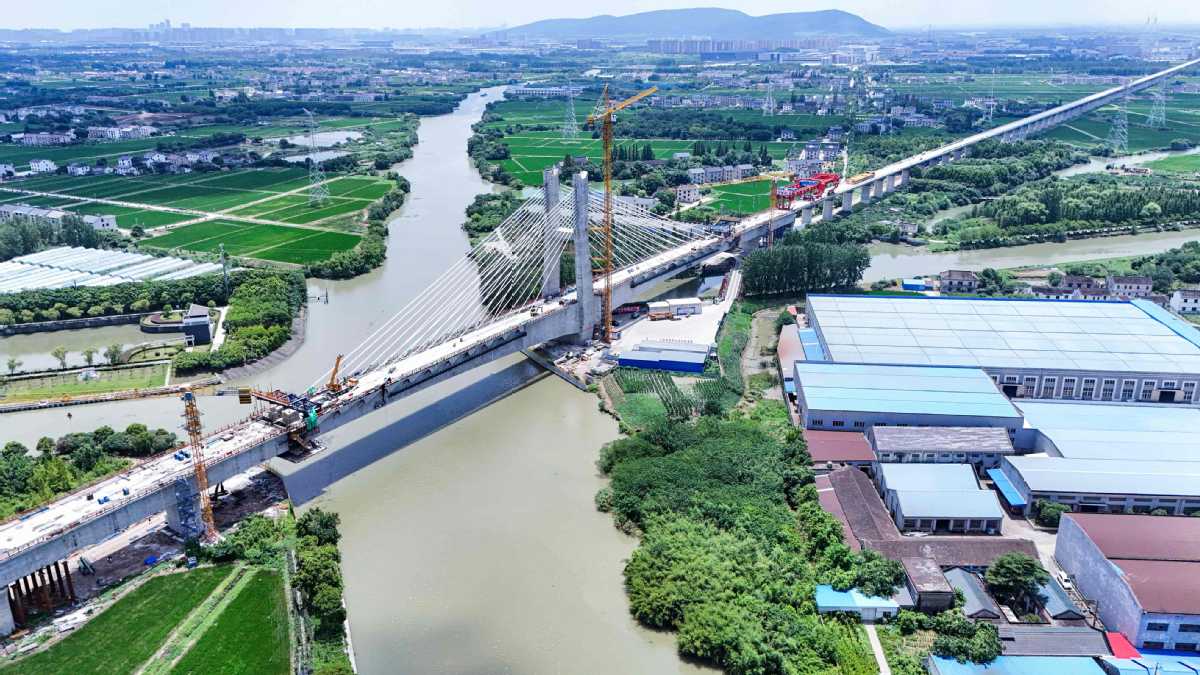
The Zhangjiagang River cable-stayed bridge is located at the border between the cities of Zhangjiagang and Changshu, spanning two navigable water systems—the Zhangjiagang River and the Zoumatang River—with a total length of 417.7 meters. The bridge adopts a single-tower, double-cable-plane prestressed concrete low-tower cable-stayed design, with the bridge tower H-shaped in the transverse direction and a single tower column in the longitudinal direction. A total of 11 pairs of fan-shaped stay cables are arranged across the bridge, with a cable spacing of 1.2 meters on the tower and 9 meters on the girder. This precise structural layout imposes stringent millimeter-level standards on construction alignment and cable force control.
As a controlling key project on the entire line, it presents numerous construction challenges, including a complex waterside environment, strong alignment coupling, prominent high-altitude risks, and a tight schedule. Facing multiple challenges, the China Railway No. 5 Engineering Group project team took multiple measures to overcome difficulties, breaking through technical bottlenecks one by one through process innovation and refined control. During the pile foundation construction stage, addressing the problems of easy hole collapse and difficult sediment control in ultra-long pile foundations under complex geological conditions, the team adopted reverse circulation drilling rigs combined with bentonite slurry wall protection, and carried out refined hole cleaning through an air-lift reverse circulation process. All pile foundations on the bridge were rated Class I high-quality pile foundations, consolidating the project's foundation.
In the construction of deep foundation pits near the river, the cofferdam construction parameters were optimized through finite element numerical simulation, giving full play to the support effectiveness of the retaining piles while strictly controlling construction costs. Relying on an intelligent monitoring system, 24-hour uninterrupted monitoring of the foundation pit was achieved, ensuring the safety of waterside construction. During the main structure construction stage, addressing the difficulties of variable angles of stay-cable anchorage tooth blocks, difficult control of forming precision, and high requirements for cable cutting and anti-slip precision, the project optimized the use of a split-type tooth block formwork process to precisely control component forming quality and save schedule and cost. It innovatively applied a new adjustable bidirectional anti-slip system to achieve millimeter-level precise adjustment, effectively solving the problem of cable force deviation and eliminating hidden risks of cable slippage and wear during the operational period.
During the closure construction stage, addressing the difficulties of large self-weight loads in cantilever casting with form travelers in curved sections, narrow working surfaces, and high difficulty in alignment control, the team adopted 3D modeling rehearsal and real-time dynamic fine-tuning with total stations, and equipped form travelers with an intelligent monitoring system to prevent and control high-altitude risks, successfully completing precise closure of the girder through high-standard refined construction.
In addition, given the characteristics of construction over two river channels, the project department strictly implemented the navigation protection plan and scientifically planned construction window periods. While ensuring the normal navigation of the Zhangjiagang River and Zoumatang River, it efficiently advanced construction of each process, achieving coordinated progress in safe production, engineering construction, and navigation assurance, and successfully completing the closure milestone target.
Deng Chuqian, head of the First Sub-section of the China Railway No. 5 Engineering Group's Nantong–Suzhou–Jiaxing–Ningbo High-Speed Railway project, introduced: "In response to the characteristics of construction over two river channels, the project department strictly implemented the special navigation protection plan, scientifically assessed and reasonably planned construction window periods, and on the basis of ensuring the normal navigation of the Zhangjiagang River and Zoumatang River, efficiently advanced various construction processes, with coordinated efforts in safe production, engineering construction, and river navigation assurance."
The Nantong–Suzhou–Jiaxing–Ningbo High-Speed Railway is an important component of the coastal corridor of China's "Eight Vertical and Eight Horizontal" high-speed rail network. Starting from Nantong West Station on the Yancheng–Nantong High-Speed Railway, it runs south through Suzhou City in Jiangsu Province and Jiaxing City and Ningbo City in Zhejiang Province, and connects into Ningbo Station at the Ningbo hub. The newly built line is 301 kilometers long, with a design speed of 350 kilometers per hour, 10 stations across the entire line, and a construction period of 5 years. Once completed, the Nantong–Suzhou–Jiaxing–Ningbo High-Speed Railway will connect with multiple lines including the Yancheng–Nantong High-Speed Railway, the Shanghai–Kunming High-Speed Railway, and the Ningbo–Taizhou–Wenzhou Railway. It is of great significance for building a "Yangtze River Delta on Rails," improving the regional road network structure and layout, facilitating travel for people along the line, and supporting the integrated high-quality development of the Yangtze River Delta.
Source: China Daily
Government-Insurance Collaboration Empowers Global Expansion! Helping Yuchai Rotary Drilling Rigs Enter Global Markets
下一篇XCMG's First Overseas New Energy Factory Goes into Production in Indonesia

2026-09-28 1157 0

2026-09-24 10586 0

2026-09-23 10714 0

2026-09-22 10808 0

Lize City Air Terminal Underground Main Structure Nearing Completion: Maximum Transfer Walk Under 4 Minutes After Operation

Anti-seepage Curtain for Main Lock Pit of CSCEC Port Shenqiu Double-Line Lock Project Completed on Schedule

All Pile Foundations Completed on Quanzhou Baiqi Channel

Hainan Upgrades Housing and Municipal Infrastructure

First Foundation Concrete Pour Successfully Completed for Zambia Kafue West–Muzuma 330kV Transmission Line EPC Project
Hot News

评论 (0)