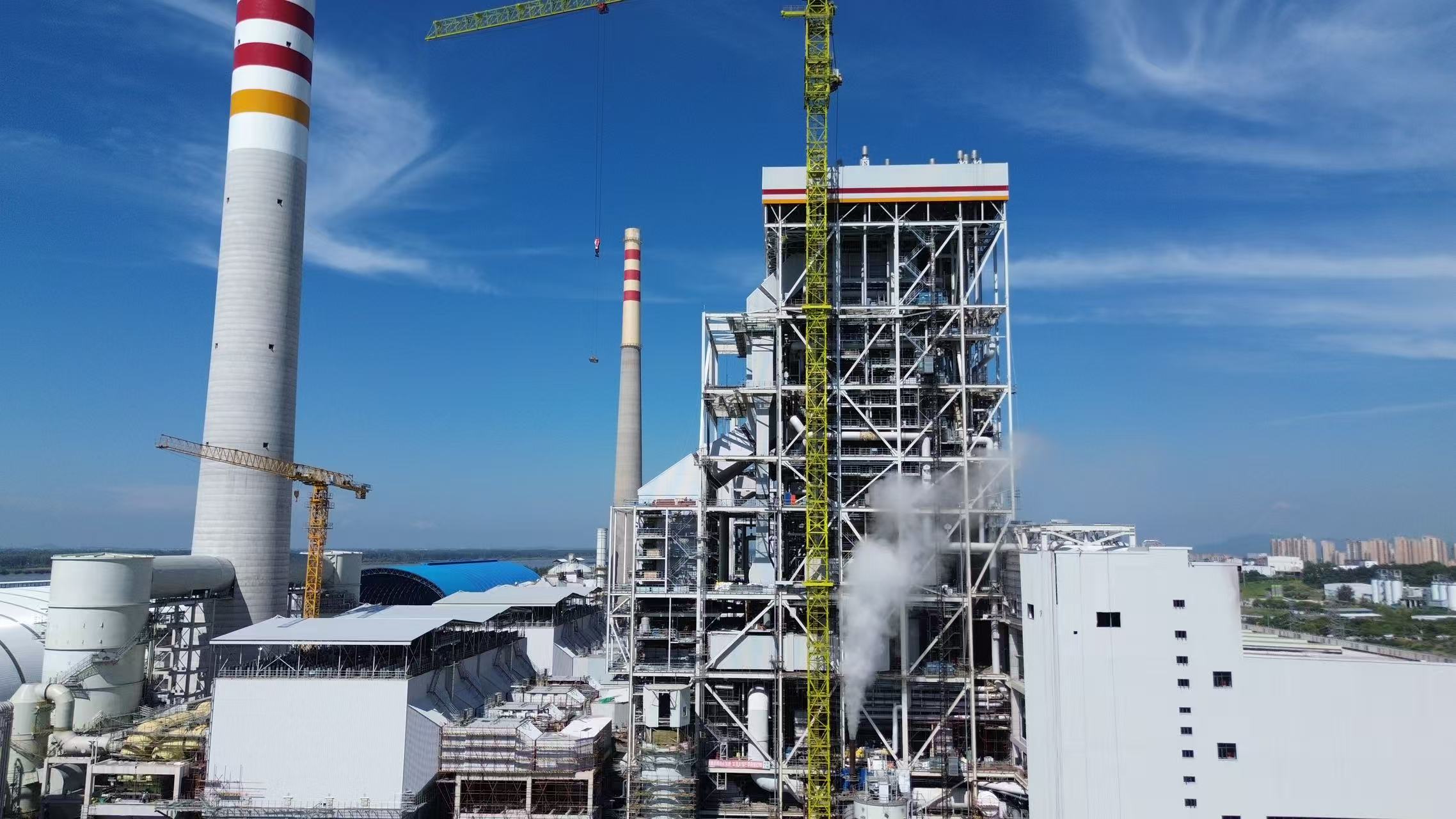
The Yangtze River surges forward, ceaseless day and night. Where the land of southern Anhui meets the golden waterway, a modern power plant stands towering, its silver-gray main powerhouse gleaming in the morning light. This is the site of the Phase II 2×660MW coal-fired power generation unit expansion project of the Shenwan Chizhou Power Plant under the China Energy Investment Corporation—a corner once covered by tidal flats and wild grass, now risen as a new landmark of clean, efficient, and intelligent energy.
From the pouring of the first batch of concrete to the successful grid connection of the units, from the muddy foundation pits during the continuous plum rains to the successful conclusion of the 168-hour full-load trial operation, more than 600 days and nights of hard work not only built a power plant but also forged an iron army of power construction workers of the new era who are "especially able to endure hardship, especially able to fight, and especially able to dedicate themselves." With the sense of responsibility of those who "serve the great interests of the nation," the craftsmanship of "weighing every millimeter," and the boldness of "daring to be first," they have lit up a beacon of high-quality development for China Power Construction on the banks of the Yangtze.
The System as the Framework: Building a High-Quality Foundation with the Power of Institutions
A major energy project is not only a battle of technology but also a test of management. From the very start of the Chizhou Phase II project, it faced multiple challenges including complex geology, a tight schedule, and dense overlapping operations. Facing this "hard nut to crack," the project team did not shrink back; instead, it tackled the problem with systematic thinking and built a scientific, efficient, and closed-loop modern engineering management system.
"Without systematic management, even the greatest determination is empty talk!" This statement by Project Manager Chang Feng at the mobilization meeting became the shared consensus for all builders. Thus the "three meetings and three systems" management mechanism came into being: the daily stand-up meeting, focusing on "five minutes for safety" to instill safety awareness in every mind; the weekly coordination meeting, adhering to "two hours to solve problems" to ensure issues do not drag past the day; and the monthly progress meeting, implementing "four hours to set the overall situation" to precisely steer the project. This mechanism is like a precision gear—tightly meshed and running in order—providing solid guarantees for the steady progress of the project.
More critically, the project broke down the traditional barrier of "design belongs to design, construction belongs to construction" and took the lead in implementing an integrated "design-construction" collaborative model. Designers intervened in advance and the construction team participated upfront, with drawing review and scheme optimization advancing in parallel. Young technician Yang Xiaohui put it vividly: "This is like a tailor taking measurements before cutting—know the body shape first, then use the scissors, and it will naturally fit." It is precisely this deep integration that resolved a large number of potential problems at the source, greatly reducing rework and delays.
Quality management was even stricter, down to the "millimeter level." The project fully implemented a lifetime quality responsibility system, publicly posting on the walls the process standards, risk points, and finished-product protection measures for every procedure, achieving "build by the drawings, operate by the rules." Ultimately, all 977 inspection lots, 108 sub-item works, and 5 sub-division works reached a 100% pass rate. Concrete pouring was excellent on the first attempt, and the project won first place in the owner's "Quality and Craftsmanship Evaluation" multiple times.
At the same time, the smart construction site initiative brought digital vitality to traditional construction. Tower crane anti-collision systems provided 24-hour intelligent warnings, environmental monitoring equipment regulated PM2.5 in real time, and BIM three-dimensional modeling pre-simulated construction conflicts in advance... With the deep integration of new technologies such as the Internet of Things, big data, and cloud computing, the site gained a "smart brain" and "clairvoyance," significantly improving management efficiency and intrinsic safety.
Innovation as the Wings: Empowering Green and Low-Carbon Transformation with Technology
Guided by the "dual carbon" goals, the Chizhou Phase II project is not only an energy project but also a practical exploration of green and low-carbon development. The project team adhered to the principle of "seeking benefits from innovation and space from technology," promoting the implementation of numerous technological and management innovations with tangible results.
To save costs and improve efficiency, the team boldly innovated by adopting a shared pile technology for boiler foundations, which not only saved more than 200 tons of steel but also reduced crane mobilization costs by more than 200,000 yuan. Facing a 3-meter-deep silt layer, technician Yang Zhen discovered through on-site surveys that abandoned cast-in-place piles could be reused as a cushion layer, cutting the replacement thickness by 1 meter and saving another 100,000 yuan. These "micro-innovations" created cumulative economic benefits exceeding 3 million yuan.
The application of BIM technology was even more exemplary. Through three-dimensional modeling and advance simulation, the project team precisely identified and resolved 68 potential issues such as steel structure hoisting path conflicts and pipeline collisions, directly shortening the construction period by 45 days and winning valuable time for subsequent commissioning.
Even more noteworthy is that the project's power supply coal consumption was as low as 266 grams per kilowatt-hour, reaching the leading level among units of the same type in China and setting a new benchmark for clean and efficient coal-fired power generation. Meanwhile, the smart construction site system enabled green construction throughout the process, with indicators such as PM2.5 and noise consistently better than national standards, truly achieving "build a power plant, protect a piece of ecology."
As a result, the project department was rated "First Place in Safe and Civilized Construction" by the owner for three consecutive months, won the first mobile red flag on the entire site, and received high recognition in multiple special inspections by the National Energy Administration and the Anhui Provincial Government.
Spirit as the Soul: Gathering the Strength to Forge Ahead Through Party Building
The success of the Chizhou project is rooted in a profound spiritual strength—the breadth of mind that "success need not be attributed to me, but my contribution is essential to success," the belief that "taking the ordinary to the extreme is extraordinary," and the loyal practice of the new-era power construction workers toward "the great interests of the nation."
The project Party branch adhered to the principle of "focusing on Party building around the project and promoting the project through good Party building," innovatively establishing "Party member responsibility zones" that divided the construction site into several responsibility units, with Party members taking the lead in tackling difficulties. At key milestones such as the hoisting of the boiler large plate girders and the closing of the turbine cylinder, Party member commando teams worked continuously in shifts to ensure nothing went wrong. "One Party member is one banner"—on this land, the Party flag has always flown high on the construction front line.
Cultural nourishment is also soft power. The project department carefully created cultural carriers such as a cultural corridor and a Beijing-style gatehouse, which not only display the image of a central state-owned enterprise but also provide a spiritual home for employees. At the same time, it actively carried out public welfare activities such as comforting the families of martyrs and assisting disaster-affected people, enabling project builders to spread warmth and fulfill social responsibility even in a foreign land.
"A benchmark doesn't depend on one person, but on everyone doing every little thing well." This simple saying has become the conscious action of all builders. From adjusting the angle of clothes-drying racks in the living area to optimizing network cabling in the office area to controlling the flatness of weld seams—everything has someone responsible, and every matter gets a response. It is precisely this extreme pursuit of detail that forged the project's outstanding quality.
Struggle as the Pen: Writing the Extraordinary Through Ordinary Perseverance
Behind a great project are ordinary yet resilient figures. At the Chizhou project, the most moving thing is not the roar of machinery but the perseverance and warmth hidden behind the data.
Chief Engineer Yu Pengcai's "25-day legend" is still talked about with relish by his workmates. From receiving the transfer order to arriving at the site, he completed the cross-provincial handover in just 24 hours. In the June plum rain season, with 40°C heat mixed with continuous drizzle, more than ten thousand cubic meters of silt churned like a swamp in the foundation pit. He led the team to survey repeatedly, stumbling through mud, changing two sets of work clothes a day, with sweat pooling into small puddles inside their rain boots. Under such conditions, they managed to catch up in 25 days with the progress of Section A, which had entered the site half a month earlier. When the first batch of concrete was poured on schedule, the chief supervisor said excitedly: "You have created the 'Chizhou Speed'!"
Project Manager Chang Feng's "figure in the rainy night" is equally moving. When a rainstorm struck suddenly, at three in the morning, he was the first to rush into the site to inspect the drainage system. Soaked to the bone, he smiled and said to his colleagues: "Isn't this nice and cool?"—a simple remark that reveals the optimism and sense of responsibility of power construction workers finding joy in hardship.
Technician Tian Tong interpreted the craftsman spirit with "millimeter-level" persistence. Before the hoisting of the boiler steel frame, he compared data for 72 consecutive hours and worked with the design institute to optimize the pile foundation scheme. The moment the scheme was approved, the young man's eyes filled with tears: "Chief Yu often says 'be responsible to the project and to the company.' Now I truly understand the weight of those words."
There is also Project Manager Assistant Li Kunfeng's "New Year's Eve vigil." On a night of family reunion, he chose to stay at the site to watch over the key milestone of boiler installation. Fireworks blazed in the distance, welding sparks flew nearby, and under the searchlights was a special "reunion scene." On the other end of the phone, his child asked: "Dad, when are you coming home?" He replied softly: "I'll come back to be with you once the project is done."—this promise is the shared voice of countless builders.
The warmth of the project department is also reflected in the little things: during the hot season, every worker received a "heatstroke prevention kit" containing Huoxiang Zhengqi water, cooling oil, and a handwritten blessing card; the canteen brewed mung bean soup daily and had it delivered to the work faces by dedicated staff. These seemingly small gestures, like spring rain, gathered people's hearts and inspired their drive.
Today, the Chizhou Phase II power plant has officially entered commercial operation, and a steady stream of clean electricity is being delivered to thousands of households. Standing on the rooftop of the main powerhouse and looking into the distance, the Yangtze rolls eastward, and the plant's lights pour out like a galaxy. Here there is the coldness of steel and the heat of passion; the precision of technology and the purity of original aspiration. When the first kilowatt-hour of electricity is sent out from here, what it lights up is not only the thousands of lights of southern Anhui but also a spirit—breaking through in the face of challenges, innovating through perseverance, and passing on through dedication. This spirit, like the waters of the Yangtze, flows on ceaselessly; like the light of energy, it illuminates the future.
September 2025 Construction Machinery Products Import and Export Flash Report
下一篇When the "Black Soil Granary" Meets Green Power! Zoomlion's Hybrid High-Horsepower Tractor Wins Praise in Its Heilongjiang Debut

2026-10-18 0 0

2026-10-18 0 0

2026-10-17 0 0

2026-09-23 10598 0
Lize City Air Terminal Underground Main Structure Nearing Completion: Maximum Transfer Walk Under 4 Minutes After Operation
Anti-seepage Curtain for Main Lock Pit of CSCEC Port Shenqiu Double-Line Lock Project Completed on Schedule
All Pile Foundations Completed on Quanzhou Baiqi Channel

Hainan Upgrades Housing and Municipal Infrastructure
First Foundation Concrete Pour Successfully Completed for Zambia Kafue West–Muzuma 330kV Transmission Line EPC Project
Hot News

评论 (0)