
Research Background
As one of the regions with the most intense tectonic activity in the world, the Qinghai-Tibet Plateau experiences frequent geological disasters due to the coupling of internal and external dynamic processes, posing serious threats to major projects (such as railways, hydropower, and oil pipelines). Based on more than 20 years of field work by the team and supported by national science and technology projects, the research focuses on three core issues:
Engineering route and site selection in strongly tectonically active areas
Mechanisms of high-position and long-runout geological disasters
Rockburst risk in deep-buried tunnels
Main Research Results
1. Theoretical Innovation in Engineering Route and Site Selection
Multi-scale stability evaluation system: A three-level evaluation method of "regional crustal stability-engineering geological stability-site stability" is proposed and applied to the route optimization of the Yunnan-Tibet Railway, significantly reducing the impact of active faults.
Case: The Lijiang-Shangri-La section avoids the eastern piedmont fault of Yulong Snow Mountain by adjusting the route alignment, reducing tunnel burial depth and construction risk.
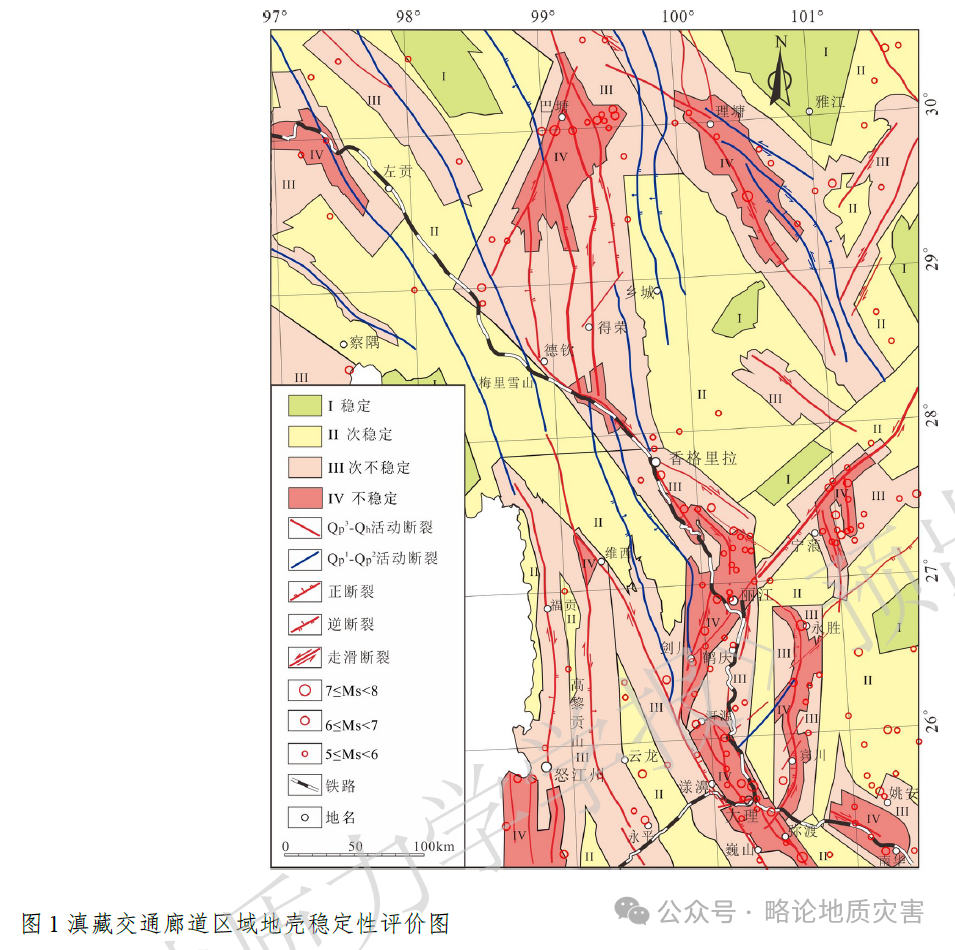


2. Breakthroughs in Geological Disaster Prevention and Control
Disaster effects of active faults: It is revealed that fault zones aggravate landslide and debris flow disasters through mechanisms such as topographic modification, stress field disturbance, and source material supply.
Geomechanical models of high-position landslides: Six types of landslide-controlling models are proposed (such as the accumulation body sliding type and the tectonic control type), elucidating the joint landslide-controlling mechanism of tectonic suture zones and altered soft rocks in cases such as the Baige landslide.
Disaster prevention application: It provides a theoretical basis for the early identification of landslides along the Sichuan-Tibet transportation corridor.


3. Rockburst Prevention and Control Technology for Deep-Buried Tunnels
Influence of tectonic stress: The geometric relationship between the tunnel axis and folds/faults significantly affects rockburst intensity (for example, the risk is highest when parallel to the fold axis).
Prevention and control countermeasures:
Planning stage: Optimize the tunnel axis direction, giving priority to being parallel to the maximum principal stress;
Construction stage: Adopt circular cross-sections, advance pilot tunnels for pressure relief, and high-strength support systems;
Monitoring and early warning: Combine microseismic and real-time stress monitoring.


Future Outlook
Theoretical development: Cross-scale dynamic modeling, quantification of catastrophic processes, and integration of reliability analysis.
Technological expansion: Integration of space-air-ground multi-source monitoring with AI, early warning of extreme disaster chains, and construction of deep three-dimensional geomechanical models.
Planetary geology application: Explore engineering geological stability evaluation methods for extraterrestrial base site selection.
(1) In conjunction with the route and site selection of major projects, the theory of regional crustal stability evaluation has been inherited and developed, and a survey and evaluation method of regional crustal stability-engineering geological stability-site stability has been proposed, effectively serving the route and site selection of major projects.
(2) In conjunction with the prevention and control of major geological disaster risks, an engineering geological research framework for active tectonic belts has been proposed, the geological disaster effects of active faults have been elucidated, geomechanical models of high-position landslides have been constructed, and the joint landslide-controlling mechanism of geological structures and special lithology has been revealed.
(3) In conjunction with the prevention and control of geological safety risks in deep-buried tunnels, the differences in tunnel rockburst characteristics under different tectonic environments have been comparatively analyzed, and based on research on the rockburst mechanism of deep-buried tunnels using measured in-situ stress, countermeasures for tunnel rockburst prevention and control under high in-situ stress environments have been proposed.
(4) Geomechanics theory and methods have played an indispensable role in the planning and construction of national major projects. In the future, research on geomechanics in theoretical innovation and engineering application should continue to be strengthened, especially in the expansion of engineering applications and planetary geoscience.
Knowledge Sharing | Int. J. Impact Eng: Capturing the Pressure- and Rate-Dependent Behavior of Rock with a New Damage Plasticity Model
下一篇Corporate News | A Batch of Key Projects by China Construction Fifth Engineering Division Reach Topping Out

2026-10-18 0 0

2026-10-18 0 0

2026-10-17 0 0

2026-09-23 10598 0
Lize City Air Terminal Underground Main Structure Nearing Completion: Maximum Transfer Walk Under 4 Minutes After Operation
Anti-seepage Curtain for Main Lock Pit of CSCEC Port Shenqiu Double-Line Lock Project Completed on Schedule
All Pile Foundations Completed on Quanzhou Baiqi Channel

Hainan Upgrades Housing and Municipal Infrastructure

First Foundation Concrete Pour Successfully Completed for Zambia Kafue West–Muzuma 330kV Transmission Line EPC Project
Hot News

评论 (0)