Title
Title
Paper Information Information Journal: Computers and Geotechnics Authors: Guodong Ma a, Annan Zhou a*, Ha H. Bui b. Affiliation: a: Department of Civil and Infrastructure Engineering, School of Engineering, Royal Melbourne Institute of Technology (RMIT) University, Melbourne, Victoria, Australia b: Department of Civil and Environmental Engineering, Monash University, Clayton, Victoria, Australia Abstract Abstract Rainfall-induced instability of unsaturated soil slopes is one of the most common and destructive types of landslides worldwide, often causing significant casualties and economic losses. Accurate prediction of such instability requires not only a robust numerical method capable of capturing the coupled hydraulic and mechanical behavior of unsaturated soils, but also a comprehensive understanding of the influence of spatial variability in soil properties on slope stability. In this study, smoothed particle hydrodynamics (SPH) combined with an advanced unsaturated constitutive model is employed for the first time to investigate the effects of void ratio dependence and variability on rainfall-induced instability of unsaturated soil slopes. The model is capable of capturing the hydro-mechanical coupling behavior of unsaturated soils, accounting for the influence of void ratio on water retention, infiltration, and strength characteristics. A single-layer multiphase SPH method is adopted, in which each particle simultaneously represents the water, air, andsolid phasesenabling efficient and robust simulation of large deformation problems. The SPH model is applied to synthetic slopes with spatially variable soil properties to explore how void ratio heterogeneity alters failure mechanisms and initiation conditions. The results provide new insights into the role of void ratio heterogeneity in rainfall-induced landslides and demonstrate the potential of the advanced SPH model for practical probabilistic analysis in geotechnical engineering applications.
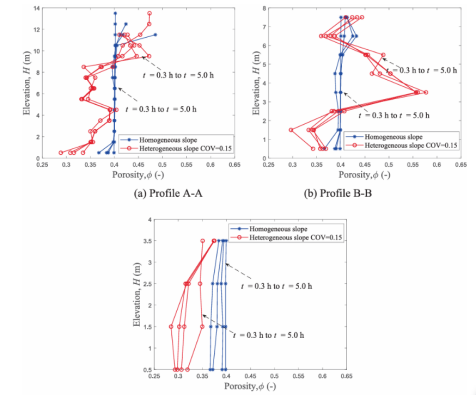
Figures & Tables Figures & Tables Fig. 1 Degree of saturation and relative permeability coefficient under different void ratios. Fig. 2 Constitutive model of secondary loading and yield surface Fig. 3 SPH setup for granular collapse. Fig. 4 Comparison of granular collapse geometry. Fig. 5 Influence of initial void ratio and initial suction on the performance of the constitutive model. Fig. 6 Evolution of porosity in homogeneous and heterogeneous slopes. Fig. 7 Evolution of mean effective stress in homogeneous and heterogeneous slopes. Fig. 8 Displacements at locations D, E, and F in homogeneous and heterogeneous slopes. Conclusion Conclusion In this study, a fully coupled smoothed particle hydrodynamics (SPH) numerical framework was developed and implemented to investigate rainfall-induced instability of unsaturated slopes, with particular attention to the dependence and variability of void ratio in unsaturated soils. An advanced unsaturated constitutive model was successfully integrated into the SPH framework to capture the complex hydro-mechanical interactions during slope instability. The performance of the unsaturated constitutive model was first verified at the element level, and then validated through SPH simple shear tests and granular collapse tests. The fully coupled SPH model was applied to a rainfall infiltration scenario on an unsaturated embankment slope, providing key insights into how the spatial heterogeneity of porosity affects water infiltration patterns, pore pressure development, effective stress, and slope stability. Increased spatial variability of void ratio generally enhances the potential instability of slopes and creates more preferential paths for seepage. As a result, the infiltration time is shortened, and soil strength is reduced due to significant changes in density. The numerical results show that when the spatial variability of void ratio increases, the sliding area at slope failure expands, but its influence on slip distance is limited. At the same time, it also leads to earlier occurrence of slope failure. Overall, the proposed smoothed particle hydrodynamics (SPH)-based approach provides a robust and efficient tool for analyzing complex slope failure mechanisms in unsaturated soils. These findings provide valuable guidance and lay a solid foundation for future probabilistic and performance-based slope stability assessments of heterogeneous geomaterials under rainfall conditions. References References Guodong Ma, Annan Zhou, Ha H. Bui. Smoothed particle hydrodynamics (SPH) modelling for rainfall-induced unsaturated slope failure considering void ratio dependence and variability. Computers and Geotechnics 189 (2026) 107629.




Personality Spotlight | Li Jitao — SANY's "Iron Army" on the Land of Jinan
下一篇Gathering Industry Wisdom to Empower Geotechnical Engineering | Ruima Marujian Technical Exchange Event

2026-09-28 1157 0

2026-09-24 10586 0

2026-09-23 10714 0

2026-09-22 10808 0

Lize City Air Terminal Underground Main Structure Nearing Completion: Maximum Transfer Walk Under 4 Minutes After Operation

Anti-seepage Curtain for Main Lock Pit of CSCEC Port Shenqiu Double-Line Lock Project Completed on Schedule

All Pile Foundations Completed on Quanzhou Baiqi Channel

Hainan Upgrades Housing and Municipal Infrastructure

First Foundation Concrete Pour Successfully Completed for Zambia Kafue West–Muzuma 330kV Transmission Line EPC Project
Hot News

评论 (0)