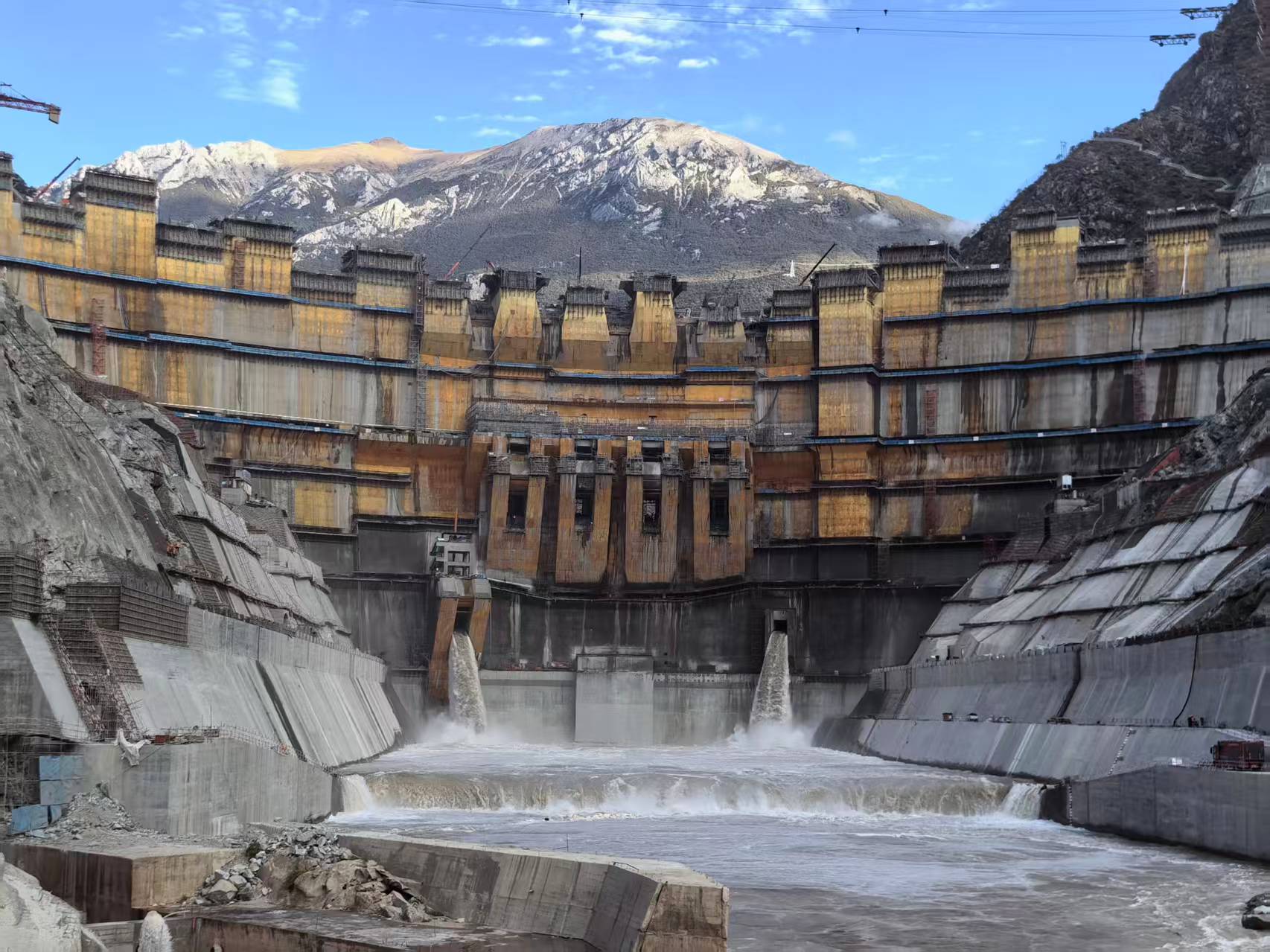
Deep in the Jinsha River gorge at the border of Sichuan and Tibet, a 217-meter-high extra-high arch dam rises steeply, its concrete placement height having surpassed 200 meters, with some dam sections already poured to the top, holding back the river like a giant—this is the Yebatan Hydropower Station, a backbone power source of the national "West-to-East Power Transmission" project and a key project in the cascade development of the upper Jinsha River.
Recently, the gates of this super project slowly descended, the surging river gradually rose, and 2.24 million kilowatts of clean energy will set sail here, lighting up millions of homes. Behind this historic moment lies the persistent quest of PowerChina builders across 20 years of changing seasons, an arduous journey from blueprint to reality, and a vivid portrayal of a generation of builders forging craftsmanship with their original aspiration and overcoming countless difficulties through perseverance.
Pioneering the Gorge: Twenty Years of Trials and Hardships, Measuring the Engineering Foundation with Footsteps
Time goes back twenty years, when the upper Jinsha River gorge was still a remote and rarely visited secret realm. When the project began preliminary planning and research, and the first batch of geologists from Chengdu Engineering Corporation (Chengdu Institute) stepped in carrying compasses and geological hammers, the steepness before them far exceeded imagination—there were no formed roads, and the steep cliffs could only allow one person to pass sideways; in the cold, oxygen-deficient environment, every step required several times more effort than on the plains; the biting cold wind, carrying sand and stones, stung their faces like knives. "Back then there were no decent camps at all, just a few tents set up in the mountain hollows. In summer it was as stuffy as a steamer, and the mosquitoes could cover you in bites; in winter, when heavy snow sealed the mountains, the temperature inside the tents could drop to more than ten degrees below zero. At night we slept wrapped in three layers of quilts, and in the morning the water in the washbasins had frozen." An old team member who participated in the early surveys recalled those days with deep emotion.
In such an environment, the geologists began their journey of "measuring the mountains and rivers with their footsteps." They set out before dawn every day, carrying dry rations and instruments, climbing through the gorge and surveying and recording every rock and every fault. Altitude sickness was a constant companion; many suffered headaches and chest tightness, yet merely continued after relieving the symptoms with oxygen. Loneliness was the norm; communication between the camp and the outside world relied basically on shouting, and to make a phone call one had to hike for hours down to a township at the foot of the mountain, sometimes waiting most of a day to get through. But no one backed down, because everyone held a goal in their heart: to ascertain the geological "family background" of the Yebatan Hydropower Station and draw the most accurate blueprint.
In the 2005 flood season, a sudden debris flow brought a life-and-death test to the survey team. At that time, the team members were working in Zhongzan Township, Batang County, when a debris flow triggered by torrential rain instantly destroyed the only road out of the mountains, trapping them in the gorge. On the verge of running out of water and food, the team leader responded calmly, contacting the outside world by satellite phone while leading the team members to analyze the terrain and, guided by local villagers, feel their way along the steep slopes. In the pitch-black night, holding hands and stepping through the mud, they hiked for four hours, one deep step and one shallow step, and finally reached safety in the early morning. This escape became an unforgettable memory for the team members and made them more deeply aware that building a project in the Jinsha River gorge means not only grappling with technical challenges but also fighting against the harsh natural environment.
Afterward, the "10.11" and "11.03" Baige barrier lake geological disasters followed one after another. When landslides blocked the Jinsha River and formed barrier lakes, the Chengdu Institute team rushed to the scene at the first opportunity and, relying on rich geological experience and professional judgment, accurately concluded that the "Baige landslide had blocked the river," providing a key basis for decision-making to the emergency rescue command. Risking the breach of the barrier lake, they went deep into the core area of the landslide to survey and put forward targeted preventive recommendations, buying precious time for protecting the lives and property of people downstream.
For years on end, the geologists stayed away from their families, their footprints covering nearly 800 kilometers of the planned river section. Under oil lamps, they drew geological sketch maps stroke by stroke, recording hundreds of thousands of sets of rock mass data; on mountain paths, geological hammers worn blunt at the tips and hiking boots worn through at the soles became their "partners" in dialogue with the earth. It is precisely this tenacity to "gnaw on the hard bones" that laid the most original and also the most solid foundation for the Yebatan Hydropower Station—from the preliminary outline at the pre-feasibility stage, to the repeated refinement at the feasibility stage, and then to the meticulous polishing at the technical construction stage, every step embodies their sweat and wisdom.
Technological Breakthrough: Innovation Solves World-Class Challenges, Giving the Dam "Double Insurance"
The Yebatan Hydropower Station is called a "super project" not only because of its massive scale but also because it faces a series of world-class technical challenges—the construction of an extra-high arch dam in a cold, high-altitude environment, the treatment of a deep unloading zone only a few meters from the dam foundation, and geological risks interwoven with complex structural planes... These challenges test the builders' technical strength and innovative courage.
The deep unloading zone was the "stumbling block" in the construction of the Yebatan dam foundation. The so-called deep unloading zone refers to an area where the rock mass has loosened and fractured under long-term geological action. In conventional understanding, such an area simply cannot bear the enormous weight of an extra-high arch dam and is regarded as a "forbidden zone" for engineering construction. When the survey found this geological structure near the dam foundation, the entire team faced enormous pressure: handling it according to conventional schemes would not only greatly extend the construction period but also sharply increase costs; failing to solve it properly would directly affect the safety and stability of the dam.
The Chengdu Institute team did not back down; they decided to break conventional understanding and launch a technical assault. The team integrated experts from multiple fields such as geology, structure, and materials, and innovatively adopted a technical combination of "3D geological modeling + microseismic monitoring"—through 3D modeling, every fissure and every fault in the dam foundation rock mass was precisely presented, building a three-dimensional geological model; with microseismic monitoring, tiny activities inside the rock mass were captured in real time and their stability analyzed. After hundreds of simulation calculations and field tests, the team finally reached a key conclusion: after scientific treatment, the deeply unloaded rock mass is fully capable of bearing the load.
This breakthrough produced remarkable results: the embedment depth of the dam foundations on both banks was optimized by 30 meters, directly saving 2.8 billion yuan in project investment; at the same time, the team developed precise fault grouting technology to carry out comprehensive anti-seepage treatment of the faults around the dam foundation, enabling the dam to meet the stringent standards for an extra-high arch dam. "It is equivalent to installing 'double insurance' on the dam—reducing the load while adding reinforcement," the technical director explained.
To ensure the safety of the reservoir area, the team also carried out all-round geological hazard investigations. Team members hiked and climbed every dangerous bank in the reservoir area, marking fault locations with red paint on steep cliffs, with rock dust and sweat soaking through the geological maps they carried; in the primeval dense forests, they used GPS to record the coordinates of every monitoring point, weaving a precise surveying and mapping network. Hundreds of thousands of sets of rock mass data were entered into computers and, after repeated analysis and verification, finally formed a more than 400-page "Reservoir Impoundment Safety Appraisal Report." Those figures bent over their desks under the lamps revising the report engraved responsibility and rigor into every parameter and every conclusion.
The application of geological informatization technology pressed the "fast-forward button" for project construction. The past methods of manual measurement and hand-drawn drawings were replaced by new technologies such as UAV oblique photography and intelligent algorithms—a UAV flying over the dam foundation could construct a real-scene 3D model, with every fissure in the dam foundation revealed in fine detail; rock mass quality parameters (such as the RQD rock mass integrity index, Jv joint density, and RBI rock mass basic quality index) were automatically calculated and generated through intelligent algorithms, raising survey efficiency threefold compared with traditional methods.
The empowerment of informatization technology brought a series of chain reactions: the number of anchor cables on the dam abutments was reduced by 300, the slope excavation height was lowered by 50 meters, the construction period was shortened by 135 days, and a comprehensive investment saving of 60 million yuan was achieved. This technological innovation also won the national "Longtu Cup" championship and became a model for the application of geological informatization in the industry. As the dam's concrete was poured layer by layer, the wisdom of geological informatization had quietly been fused into the dam body's sinews, becoming the most solid technical foundation for gate closure and impoundment.
Original Aspiration as Firm as Rock: Fulfilling the Mission of a Central SOE, Forging a Green Engine for West-to-East Power Transmission
Looking back on the construction history of the Yebatan Hydropower Station, from the geological surveys twenty years ago to today's gate closure and impoundment, every step has depended on the builders' sincere collaboration and meticulous perseverance. There were no earth-shaking feats, but there was day-after-day deep cultivation—every repeated deduction of a scheme was only to find the optimal path; every rigorous drawing was only to ensure precise construction; every cubic meter of concrete quality control was only to consolidate the dam's foundation. As one builder said, "The dam is poured with concrete, but what supports it is countless people's dedication to detail."
As a backbone power source of the national "West-to-East Power Transmission" project, the Yebatan Hydropower Station carries an important strategic mission. Once completed, it will provide a large amount of clean electricity every year, reduce coal consumption, and help achieve the "dual carbon" goals; at the same time, it will coordinate scheduling with other cascade hydropower stations on the upper Jinsha River, enhance the flood control capacity of the Yangtze River basin, and safeguard downstream areas. As a central SOE, Chengdu Institute has always put national strategy first and fulfilled its mission of "serving the country and benefiting society" through practical actions.
During project construction, the team also consistently upheld the concept of ecological protection. To reduce the impact on the surrounding environment, they optimized the construction scheme to avoid large-scale excavation; they carried out vegetation restoration around the reservoir area so that project construction and ecological protection could coexist harmoniously. They aimed not only to build a dam that can generate electricity but also to build a green and sustainable dam.
When the gates of the Yebatan Hydropower Station sink into the heart of the river, the waters of the upper Jinsha River will gather here and be converted into a steady stream of clean energy, sent along transmission lines to the eastern region. This moment is not only a victory of concrete and technology but also a solemn promise written by the people of Chengdu Institute with the mountains and rivers as witness—from the first geologists to today's builders, they have spent twenty years erecting a monument in the Jinsha River gorge and also building a road of hope for clean energy.
This monument records the courage to overcome difficulties. Facing the challenges of cold, oxygen deficiency, and complex geology, the builders did not back down; they used innovation to break the deadlock and turned the "impossible" into the "possible." This monument carries the responsibility of serving the country. As a key link in "West-to-East Power Transmission," the Yebatan Hydropower Station will contribute to optimizing the national energy structure. This monument also conveys the belief in staying true to the original aspiration. From the oil lamps in the tents to the lighting at the construction site, and then to the lights that will illuminate millions of homes in the future, the people of Chengdu Institute have always practiced their original aspiration through "the merit of every kilowatt-hour," engraving the mark of the builders into the long scroll of the times.
The Jinsha River still surges on, while the Yebatan Hydropower Station will stand quietly here, lighting the future with clean energy. It bears witness to the wisdom and responsibility of China's hydropower builders and to the vigorous development of the national energy cause. On the road toward the "dual carbon" goals, the Yebatan Hydropower Station will, as a green engine, inject a steady stream of momentum into the development of the new era.
Benefiting 1.12 Million People! Yunnan Zhaolu Large-scale Irrigation District Upgrade and Renovation Project Breaks Ground
下一篇Ye'ertan Hydropower Station Successfully Closes Gates for Water Storage

2026-10-18 0 0

2026-10-18 0 0

2026-10-17 0 0

2026-09-23 10598 0
Lize City Air Terminal Underground Main Structure Nearing Completion: Maximum Transfer Walk Under 4 Minutes After Operation
Anti-seepage Curtain for Main Lock Pit of CSCEC Port Shenqiu Double-Line Lock Project Completed on Schedule
All Pile Foundations Completed on Quanzhou Baiqi Channel

Hainan Upgrades Housing and Municipal Infrastructure
First Foundation Concrete Pour Successfully Completed for Zambia Kafue West–Muzuma 330kV Transmission Line EPC Project
Hot News

评论 (0)