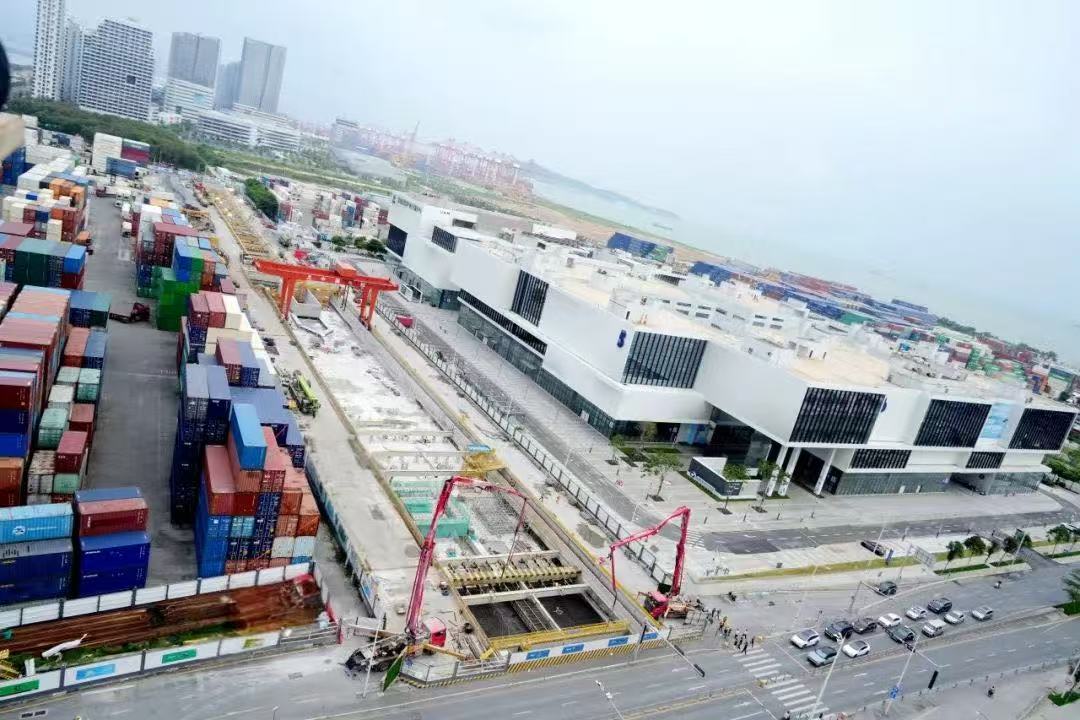
Beneath the ground of Shenzhen, a city surging with innovative vitality, an engineering miracle of "precise assembly" is quietly unfolding. As a key node of Shenzhen Metro Line 15, Haicheng Station, in the new form of a composite-layer prefabricated station, breaks through the construction constraints of traditional metro stations' "on-site casting," assembling underground space like giant "building blocks." And in this "block-assembly" project, the surveying team of Shenzhen Metro Line 15 is the core "gatekeeper" holding the "measuring tape"—they take millimeter-level precision as their criterion, making every "block" fit perfectly, interpreting the core value of engineering construction with precise data, and writing a legend of precision in underground engineering.
Base slab embedded part surveying: building the first benchmark of the "blocks" with a ±2 mm error
The construction of a prefabricated station is just like the opening of building blocks. The stability of the "base" directly determines the installation orientation of all subsequent components. As the "initial assembly point" of the entire station structure, the base slab embedded parts of Haicheng Station have positional precision that can be called the "first ruler" of the project. The surveying team well understands the decisive significance of this stage; even before base slab construction began, they completed the re-survey and densification of the entire station control network in advance, strictly controlling the basic survey error within ±2 mm, thus laying a solid "data baseline" for subsequent construction.
At the critical stage of embedded part installation, surveyors innovatively adopted a "dual-instrument verification" mode: one total station tracked the planar coordinates of the embedded parts in real time to ensure no deviation in lateral position, while an electronic level simultaneously monitored elevation changes to guarantee accurate vertical height. Whether it was the slight displacement of embedded parts that might be caused during rebar tying, or the final calibration before concrete pouring, the surveying team always stayed on site, working 24-hour shifts to monitor and control, never letting any precision hazard slip by. "The coordinates of every embedded part must be checked more than three times repeatedly, so that it can precisely connect with subsequent components like the 'buckle' of a building block." A remark by the project department head revealed the rigor of the surveying work. Ultimately, the installation qualification rate of the base slab embedded parts at Haicheng Station reached 100%, laying a solid foundation for this "underground block game."
Surveying of side walls, columns, and longitudinal beams: outlining the station's three-dimensional structure
If the base slab embedded parts are the "block base," then the side walls, columns, and longitudinal beams are the core "block pieces" that form the station's "skeleton." These components are all prefabricated in factories and, after being transported to the site, must be assembled by hoisting to form a three-dimensional structure. Survey control is precisely the soul of this "three-dimensional assembly."
In response to the complex and time-consuming installation process of side walls, the surveying team innovatively developed a "real-time three-dimensional coordinate monitoring method": feature points are preset in advance on the side wall precast units, and a high-precision total station is used to collect the three-dimensional coordinates of the components in real time and dynamically compare them with the design coordinates. Once a deviation exceeding 2 mm is found, the hoisting team is immediately notified to adjust, ensuring that every side wall can be "vertically aligned and seamlessly fitted." During this period, to meet the schedule and ensure precision, surveyors often worked through the night, staring at instrument screens under the site lights, guarding the structural precision with focus and dedication.
The assembly of columns and longitudinal beams is an even more extreme test of survey precision. As vertical supports, columns must have a verticality error controlled within 1/1000; as horizontal connections, longitudinal beams must not only precisely connect with the columns but also ensure that the elevations of adjacent longitudinal beams are completely consistent. To achieve this goal, the surveying team tailored a three-step process of "position first, verify second, fix last": the first step uses a total station to lock the installation position; the second step uses an electronic level to verify elevation data; and the third step conducts a third comprehensive re-survey before the component is fixed. With layer upon layer of checks, the installation deviations of the side walls, columns, and longitudinal beams at Haicheng Station were all controlled within the allowable design range, giving the station's "skeleton" a precise and stable "physique."
Surveying of the middle slab and roof slab: completing the final assembly of the "blocks"
As the middle slab and roof slab components were successively delivered to the site, the "block assembly" of Haicheng Station officially entered its final stage. The middle slab, as the station's "mid-level platform," has flatness that directly affects subsequent track laying and interior decoration quality; the roof slab, as the "top protective barrier," has installation precision that bears on the overall structural safety of the station. The surveying team carried "strict standards" through from beginning to end, making every effort to safeguard the "last mile" of the project.
For middle slab construction, surveyors focused on controlling flatness, measuring elevation point by point with an electronic level to ensure that the flatness error within each square meter did not exceed 1.5 mm. For roof slab installation, they focused on the assembly gaps with the side walls and longitudinal beams, using a combination of "feeler gauge + total station" to check the gap width at each joint one by one, ultimately achieving a maximum gap of no more than 1 mm—a precision equivalent only to the thickness of a sheet of A4 paper.
To catch up with the construction schedule, surveyors were always racing against time. Under the scorching sun, they adjusted instruments in high temperatures; late at night, they stayed at their posts despite mosquito bites, maintaining 24-hour shifts at the hoisting site. "The moment the roof slab installation was completed, it was like putting the last piece of a building block in place—I felt both excited and reassured," one survey team member said, expressing the common sentiment of the team. And this "reassurance" came from the confidence bestowed by data: the installation qualification rate of the middle slab and roof slab was 100%, bringing the "block assembly" of Haicheng Station to a perfect conclusion.
Beyond precision: using data as a shield to protect the project's "lifeline"
In the construction of the composite-layer prefabricated station at Haicheng Station, behind the "block assembly" is the core engineering value interpreted by the surveying team through data. From base slab embedded parts to roof slab components, from planar position calibration to three-dimensional coordinate monitoring, surveyors used millimeter-level precision control to not only achieve the precise assembly of every "block" but also deliver significant engineering benefits: compared with traditional on-site casting, the construction period was shortened by more than 30%, and project quality and structural safety factors were greatly improved.
This working model of "ensuring precision through surveying and promoting quality through precision" is not only the code of conduct for the surveying team of Shenzhen Metro Line 15 but has also become a core driving force for the development of prefabricated construction. In the future, amid the wave of urban rail transit construction, the surveying team will continue to use "precision" as the pen and "responsibility" as the ink to outline more perfectly fitted engineering miracles in underground space, injecting stronger "underground momentum" into the urban development of Shenzhen and even the whole country.
Main Structure of Zhangjiagang Integrated Circuit Advanced Materials Innovation Center Project Fully Topped Out
下一篇Benefiting 1.12 Million People! Yunnan Zhaolu Large-scale Irrigation District Upgrade and Renovation Project Breaks Ground

2026-10-18 0 0

2026-10-18 0 0

2026-10-17 0 0

2026-09-23 10598 0
Lize City Air Terminal Underground Main Structure Nearing Completion: Maximum Transfer Walk Under 4 Minutes After Operation
Anti-seepage Curtain for Main Lock Pit of CSCEC Port Shenqiu Double-Line Lock Project Completed on Schedule
All Pile Foundations Completed on Quanzhou Baiqi Channel

Hainan Upgrades Housing and Municipal Infrastructure
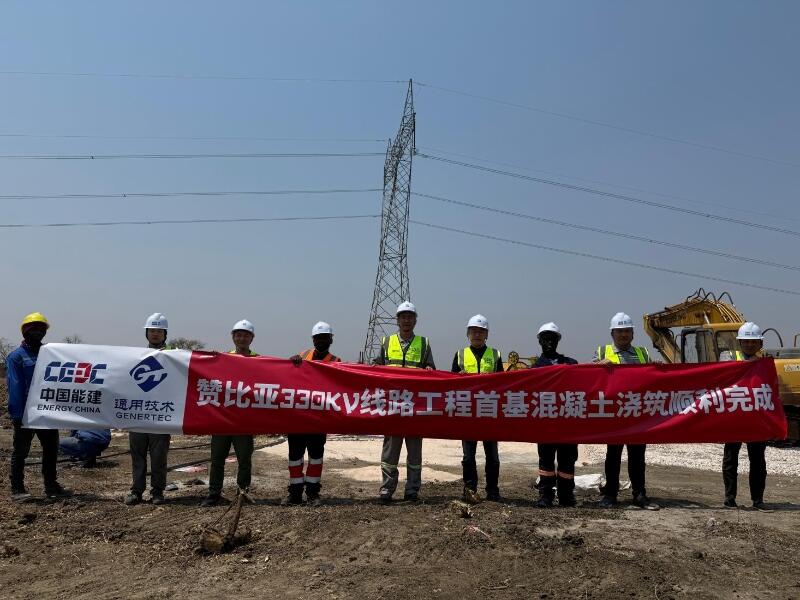
First Foundation Concrete Pour Successfully Completed for Zambia Kafue West–Muzuma 330kV Transmission Line EPC Project
Hot News

评论 (0)