Dynamic properties of low-density expandable polystyrene concrete materials
Dynamic properties of low-density expandable polystyrene concrete materials

Abstract: Expanded polystyrene (EPS) concrete has important potential application value in the field of wave absorption and vibration damping due to its environmental friendliness, energy absorption capacity, and low impedance characteristics.In this study, four density grades of EPS concrete materials were designed and prepared. Through quasi-static uniaxial compression tests and split Hopkinson pressure bar (SHPB) impact tests, the stress-strain curves, elastic modulus, failure modes, energy absorption, and strain rate effects of EPS concrete under quasi-static and dynamic loading conditions were obtained, and the influence of density on various performance indicators was analyzed.Combining the Zhu-Wang-Tang (ZWT) constitutive model with an improved elastic-brittle model, a modified dynamic constitutive model was proposed, and the accuracy of the model was verified through experimental data.The results show that the incorporation of EPS particles improves the ductility of concrete; EPS concrete exhibits a significant strain rate effect, which strengthens with increasing density; the modified constitutive model can accurately characterize the dynamic stress-strain curves of EPS concrete. Introduction: Expanded polystyrene (EPS) concrete, as an environmentally friendly green material, has been widely recognized and is extensively used in composite floor slabs, structural insulation panels, road bases, and sandwich materials. Due to its excellent energy absorption capacity and low wave impedance characteristics, EPS concrete shows great potential in wave-absorbing layer applications, effectively mitigating structural damage caused by shock waves. According to the wave impedance matching principle, the low wave impedance characteristics of EPS concrete allow more stress waves to be reflected at the wave-absorbing layer, thereby reducing stress wave transmission to deeper structures. Studies have shown that the density of EPS concrete is directly related to its stiffness, so low-density EPS concrete is more suitable for wave-absorbing layers. Currently, the design and evaluation methods for the wave-absorbing effect of EPS concrete mainly include experiments, theoretical analysis, and numerical simulation. Due to the high cost of experiments, theoretical and numerical studies are more commonly used. Accurately characterizing the material properties of EPS concrete (especially under shock wave action) is crucial, so establishing accurate quasi-static and dynamic constitutive models is key to ensuring the accuracy of theoretical analysis and numerical simulation. Numerous studies have investigated the mix design and static mechanical properties of EPS concrete, including microstructure models, uniaxial compression stress-strain models, the effects of dry density and curing age on basic properties, and the effects of EPS particle content, particle size, and distribution on mechanical properties. Scholars have also studied the dynamic mechanical properties of EPS concrete. Liu et al. studied the impact behavior of EPS concrete at impact velocities of 2-4 m/s; Lu et al. used a split Hopkinson pressure bar (SHPB) system to evaluate the impact compression performance of EPS concrete and found that the energy absorption effect was optimal when the EPS particle volume replacement rate was 20%; Chen et al. explored the strain rate effect of EPS concrete with EPS content of 0%-58.28% and found that EPS concrete with particle sizes of 3-5 mm had better energy absorption capacity. Scholars have conducted research on dynamic constitutive models incorporating strain rate effects, including viscoelastic, viscoplastic, and damage models. Viscoelastic models (especially the well-known Zhu-Wang-Tang (ZWT) model) are widely used to describe the stress-strain relationship of concrete. This model was originally used to characterize the nonlinear viscoelastic behavior of polymer materials and can effectively capture the significant hysteresis effects and viscoelastic characteristics of concrete at high strain rates. Many scholars have improved the ZWT constitutive model for polymer materials, concrete, and soil: Xiao et al. used the ZWT model to predict the elastic behavior of epoxy resin over a wide strain rate range; Yan et al. evaluated the dynamic mechanical properties of basalt polypropylene fiber concrete and established a rate-dependent plastic damage constitutive model based on the ZWT model; Wu et al. studied lightweight shaleceramsite concretedamage characteristics and constitutive models under coupled static and dynamic loading, proposing a physically meaningful dynamic damage constitutive model based on the ZWT model; Zhang et al. studied the dynamic mechanical properties of polypropylene fiber coral sea sand concrete and established a rate-dependent plastic damage constitutive model based on the ZWT model; Li et al. combined the ZWT model with plasticity theory satisfying the Drucker-Prager (D-P) yield criterion to construct a viscoelastic-plastic constitutive model for frozen soil under freeze-thaw cycles and impact loading. The literature review shows that existing EPS concrete research mainly focuses on mix design and static mechanical properties with low EPS particle content (i.e., high-density systems), while research on the dynamic mechanical properties and constitutive models of low-density EPS concrete with EPS particle content exceeding 40% and density below 900 kg/m³ is limited. In addition, the mechanical properties of high-density EPS concrete are similar to those of ordinary concrete, while the mechanical properties of low-density EPS concrete show significant differences. Therefore, this study aims to explore the quasi-static and dynamic mechanical properties of low-density EPS concrete with high EPS particle content and to establish its dynamic constitutive model, providing basic data for the theoretical design and numerical simulation analysis of EPS concrete wave-absorbing layers. To achieve the above objectives, this study designed and prepared four different densities of EPS foamed concrete by adjusting the amount of cementitious materials. A Shimadzu universal testing machine was used for quasi-static compression tests to obtain basic mechanical performance parameters such as stress-strain curves and elastic modulus; the SHPB test system was used to study the dynamic mechanical properties of the materials, analyzing the strain rate effect, energy absorption characteristics, failure characteristics, and the influence of material density on these parameters. Based on the ZWT constitutive model and the brittle elastic model, a modified dynamic constitutive model was derived, and verification results show that the model has good predictive capability for the dynamic stress-strain curves of EPS foamed concrete. Figures and Tables

Fig. 1 Details of EPS concrete specimen series and mix proportions.

Fig. 2 (a) Casting process and wet curing of EPS concrete; (b) Microscopic characteristics of EPS concrete with different densities; (c) SHPB dynamic test specimens.
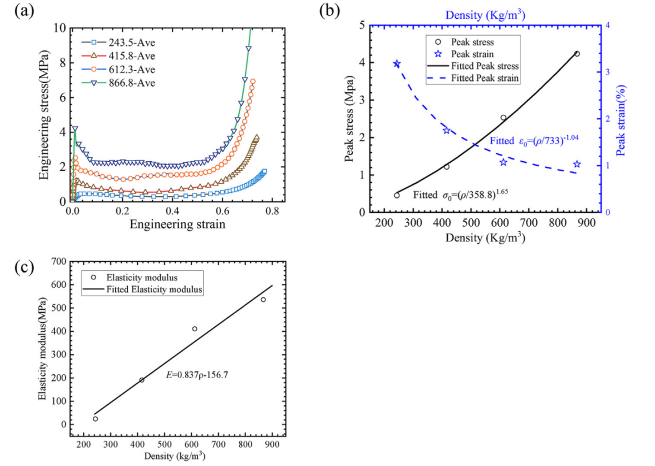
Fig. 3 (a) Stress-strain curves of EPS concrete varying with density; average engineering stress-strain curves of EPS concrete and (b) peak stress, peak strain, and (c) elastic modulus varying with density.

Fig. 4 Strength characteristics of EPS concrete。

Fig. 5 Typical failure process of EPS concrete underuniaxial compression with densities of (a) 243.5 kg/m3, (b) 415.8 kg/m3, (c) 612.3 kg/m3, and (d) 866.8 kg/m3。

Fig. 6 SHPB system, high-speed camera, and sample recovery device.

Fig. 7 Typicalincident wave, reflected wave, and transmitted wave signals of samples with densities of (a) 243.5 kg/m3, (b) 415.8 kg/m3, (c) 612.3 kg/m3, and (d) 866.8 kg/m3。

Fig. 8 Engineering stress-strain curves of EPS concrete with different densities under impact pressures of 0.1 MPa and 0.2 MPa: (a) 243.5 kg/m3 ;(b) 415.8 kg/m3 ;(c) 612.3 kg/m3 ;(d) 866.8 kg/m3。

Fig. 9 Engineering stress-strain curves of EPS concrete with different densities under impact pressures of 0.3 MPa and 0.4 MPa: (a) 243.5 kg/m3 ;(b) 415.8 kg/m3 ;(c) 612.3 kg/m3 ;(d) 866.8 kg/m3。

Fig. 10 Relationship between peak stress and strain rate: (a) 243.5 kg/m3 and 415.8 kg/m3 ;(b) 612.3 kg/m3 and 866.8 kg/m3 ;(c) Relationship between DIF and strain rate; (d) Typical dynamic stress-strain curves.

Fig. 11 Parameter fitting of the dynamic damage constitutive model.

Fig. 12 Fitting curves for various densities at gas chamber pressures of 0.1 MPa and 0.2 MPa. (a) 243.5 kg/m3 ;(b) 415.8 kg/m3 ;(c) 612.3 kg/m3 ;(d) 866.8 kg/m3。

Fig. 13 Fitting curves for various densities and gas chamber pressures of 0.3 MPa and 0.4 MPa: (a) 243.5 kg/m3 ;(b) 415.8 kg/m3 ;(c) 612.3 kg/m3 ;(d) 866.8 kg/m3。

Fig. 14Energy and strain rate: (a) incident energy; (b) reflected energy; (c) transmitted energy; (d) absorbed energy; (e) energy absorption ratio.

Fig. 15 SHPB failure processes of (a) specimen 2-1, (b) specimen 4-2, (c) specimen 6-1, (d) specimen 8-1, (e) specimen 2-7, (f) specimen 4-7, (g) specimen 6-7, and (h) specimen 8-7.
Conclusions: In this study, four densities of EPS concrete were designed and prepared, and their quasi-static and dynamic mechanical behaviors were revealed through experiments. The main findings are as follows: The higher the density of EPS concrete, the greater its peak stress and elastic modulus, but the smaller its peak strain. The incorporation of EPS particles improves the ductility of concrete and reduces the degree of cracking and damage of specimens. EPS concrete exhibits a significant strain rate effect. The dynamic increase factor (DIF) ranges of the four EPS concretes are 1.63-2.29, 2.47-3.76, 3.01-4.32, and 3.10-5.02, respectively. The proposed modified dynamic constitutive model for EPS concrete can accurately describe its dynamic stress-strain curves. These research results provide important references for the theoretical design of low-density EPS foamed concrete wave-absorbing layers and the numerical simulation of related structures. References
Han J, Fan H. Dynamic properties of low-density expandable polystyrene concrete materials[J]. Defence Technology, 2025, 43:94-108. DOI:10.1016/J.DT.2024.07.006.
They're Off! Led by the "World's No.1 Crane," Crossing Mountains and Seas
下一篇Corporate Recruitment | Launch Your Career, Seize a Rare "Foundation" Opportunity! Sinohydro Foundation Engineering 2026 Campus Recruitment Officially Kicks Off

2026-09-28 1157 0

2026-09-24 10586 0
2026-09-23 10714 0
2026-09-22 10808 0

Lize City Air Terminal Underground Main Structure Nearing Completion: Maximum Transfer Walk Under 4 Minutes After Operation

Anti-seepage Curtain for Main Lock Pit of CSCEC Port Shenqiu Double-Line Lock Project Completed on Schedule

All Pile Foundations Completed on Quanzhou Baiqi Channel

Hainan Upgrades Housing and Municipal Infrastructure

First Foundation Concrete Pour Successfully Completed for Zambia Kafue West–Muzuma 330kV Transmission Line EPC Project
Hot News

评论 (0)