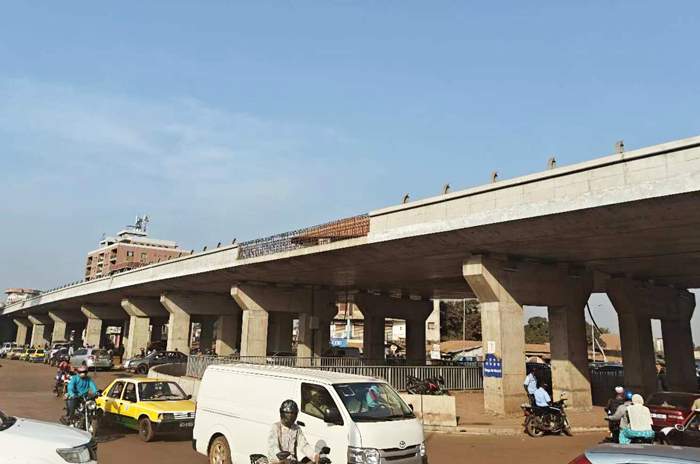
Recently, the construction site of the Bambeto Interchange Project in Conakry, the capital of Guinea, has been bustling with activity. Despite the local rainy season, the Chinese and Guinean construction teams have been working side by side, steadily advancing various tasks and striving to meet the target of opening to traffic.
The rainy season in Guinea lasts from June to November, with July to September being the period of most concentrated rainfall. Over the past month, the project site has seen an average of 27 rainy days, with cumulative rainfall exceeding 1,000 mm, while rainfall in coastal areas has been even higher. The high-temperature, high-humidity, and rainy environment has posed enormous challenges to on-site construction. Water accumulation on the site can easily cause equipment corrosion, and continuous rainfall affects the curing efficiency of concrete and also impacts material transportation.
Faced with the adverse factors of rainy-season construction, the project team formulated a special response plan for rainy-season construction in advance. In terms of material support, fully enclosed waterproof controls were implemented for moisture-sensitive materials such as formwork, rebar, and paint; rain shelters were set up and drainage ditches added to ensure the storage areas remain dry. In terms of construction organization, the division of labor among Chinese and Guinean employees was rationally coordinated, making full use of the 3 to 4-hour daily gaps between rainfall to concentrate on key processes such as welding and DBA guardrail pouring, maximizing the use of effective working time. At the same time, for the supply of key materials, the project department established a "green channel" for customs clearance and coordinated the materials team to follow up 24 hours a day, ensuring that materials such as asphalt and cement arrive on site according to the construction plan. In addition, the project department established a flood prevention and flood-season warning mechanism, monitored meteorological data daily, equipped high-power drainage pumps to pump out accumulated water from foundation pits in real time, and conducted more than 10 special flood prevention and flood control training sessions covering more than 300 Chinese and Guinean employees, enhancing the emergency response capabilities of all personnel. The project adopted a "joint training + on-the-job practice" model and has already trained 160 local skilled workers, covering multiple trades such as formwork workers, rebar workers, and machinery operators.
The Bambeto Interchange is the first three-level interchange in Guinea's national history and is a landmark project in Guinea, bearing the important task of relieving urban traffic pressure. After it officially opens to traffic, it will resolve the chronic congestion that has long plagued residents' travel, and the efficiency and experience of residents' travel are expected to be greatly improved. At present, the main structure of the project has been completed, and the T2 road repair work is proceeding in an orderly manner. As the opening date approaches, this first three-level interchange facility in Guinea will become another landmark achievement of China-Guinea joint construction of the "Belt and Road."
Shenzhen Metro's First Composite Prefabricated Station Successfully Completes Construction
下一篇PowerChina Wins the 2025 Adam Smith Award for Asia

2026-10-14 0 0
2026-09-28 36 0
2026-09-22 10749 0

2026-09-18 11026 0

Lize City Air Terminal Underground Main Structure Nearing Completion: Maximum Transfer Walk Under 4 Minutes After Operation

Anti-seepage Curtain for Main Lock Pit of CSCEC Port Shenqiu Double-Line Lock Project Completed on Schedule

All Pile Foundations Completed on Quanzhou Baiqi Channel
Hainan Upgrades Housing and Municipal Infrastructure
First Foundation Concrete Pour Successfully Completed for Zambia Kafue West–Muzuma 330kV Transmission Line EPC Project
Hot News

评论 (0)