Today we take you into the live studio of the program "Baiyun Talks Tunnels" to hear Professor He discuss the "great learning" in tunnel engineering—from key choices in his personal career, to the core secrets of talent cultivation, and on to the industry transformation in the AI era!
I.From Southwest Jiaotong University to Waseda: Tunnel Sentiment in Key Choices
Professor He's path in tunneling contains several "important turning points."
In 1987, he received his master's degree in tunnel engineering from Southwest Jiaotong University. Before that, he studied highway engineering at Chongqing Jiaotong University and also worked for 8 years. Later, through a government-sponsored study-abroad opportunity from the former State Education Commission, he entered Waseda University in Japan to pursue a doctorate, with his research direction being "seismic analysis methods for shield tunnels."

June 1987: Souvenir photo of the Class of 1987 graduates of the Department of Civil Engineering, Southwest Jiaotong University
"These study choices were so crucial!" Professor He said with emotion. Even more admirable is that in 2000, when he already held a faculty position at Waseda University, upon learning that large-scale domestic subway construction was beginning, he resolutely resigned from his faculty position and returned to Southwest Jiaotong University to devote himself to teaching and research.

2007: He Chuan (second from left) guiding students in organizing experimental data
As transportation construction shifted toward the west, mountain tunnels became a research focus, and he decisively concentrated his direction there as well. Every choice was closely tied to national needs and the pulse of the industry.
When talking about student cultivation, Professor He's answer was very practical: to become an excellent tunnel science and technology worker, one must first build "3 fundamentals"—
Solid professional knowledge (including basic theory)
A broad knowledge base
A comprehensive and correct understanding of tunnel engineering
Knowledge alone is not enough; the "3 capabilities" must also be developed:
Continuous learning ability (the industry is changing, so one must keep iterating)
Communication and collaboration spirit (an engineer's views must be accepted for things to succeed)
Unity and cooperation + leadership and organizational ability (teamwork is the norm, and one must be able to lead the team forward)

Academician He Chuan inspecting conditions on the front line of tunnel construction

Academician He Chuan conducting research during tunnel construction
"Team spirit is so important!" Professor He emphasized that this is the "invisible competitiveness" of tunnel engineering.
"Will artificial intelligence make tunnel engineers lose their jobs?" Facing this hot topic, Professor He smiled and shook his head: "On the contrary, AI is'empowerment,'and it is the 'new quality productive force' in the tunnel field!"
He explained that the prerequisite for intelligent construction is mechanization and automation, which are then integrated with informatization and AI (the achievement of the Fourth Industrial Revolution). The team also defined "intelligent tunnel construction": an upgrade based on mechanization, automation, digitalization, and informatization, integrating existing construction methods.

Looking ahead 5-10 years:
Shield method (mainly for urban tunnels and river-crossing and sea-crossing tunnels): within less than 5 years, autonomous tunneling may approach L4 level;
Drill-and-blast method (mainly for mountain tunnels): within 1-2 years, railway tunnels will fully achieve mechanization of all processes, and within 5 years, transparent judgment of surrounding rock stability can be realized.


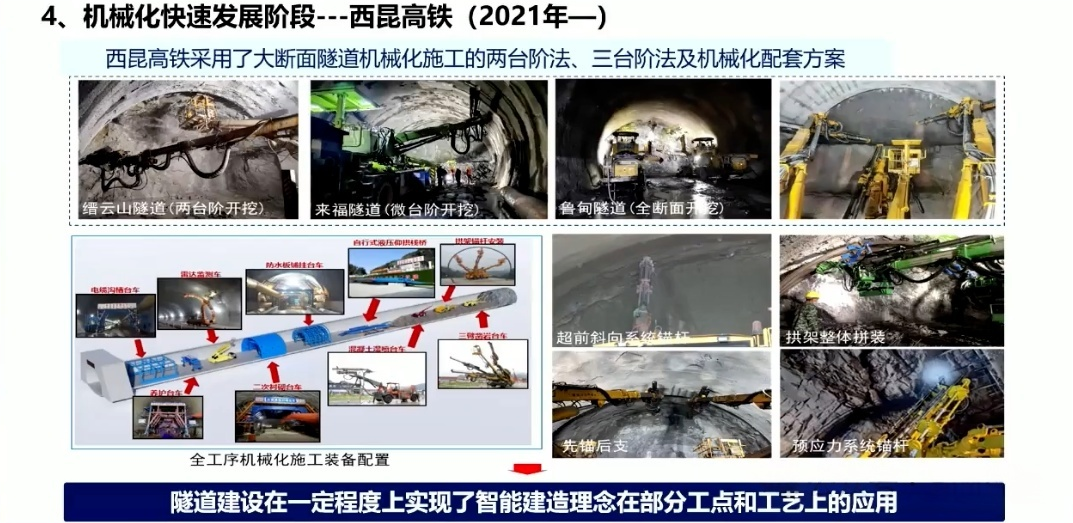
When discussing support systems, Professor He unfolded his views from multiple dimensions—philosophy, engineering, and mechanics—which was refreshing:
"Tunnel engineering faces a complex natural body—the surrounding rock—and it is the main structure." The core of support? "With the concept of minimizing disturbance and interference to the surrounding rock," for example, rock bolts and anchor cables and shotcrete are all "gentle interventions" brought by technological progress.
A more cutting-edge idea is that future support structures should form a "community of life" with the natural rock mass, like plant roots taking hold in soil, and even achieve "self-healing" (similar to blood coagulation in human wounds), greatly extending tunnel service life. Behind this is the dialectical unity of technology and nature.


Someone asked: Professor He's advisor, Akira Koizumi (an expert in shield segment design), believed that "the stiffer the segment joints, the better." Is this contradictory to the "flexibility" emphasized by the mining method? Professor He answered with a smile: "There is no contradiction; it is just a different scenario!"
Professor Koizumi's idea originated from Japan's geology: shallow cover and the need to consider earthquakes, so joints are "elastic hinges with bending resistance" that can adjust loads through strength and stiffness; while some tunnels in Europe even eliminate joints because the geology is good and earthquakes are rare.
"The key is to look at the stratum and load conditions; there is no universal principle." The wisdom of tunnel engineering lies precisely in "analyzing specific problems specifically."
Conclusion
From personal choices to the future of the industry, from technical details to philosophical thinking, Professor He's sharing showed us that tunnel engineering is not just cold steel and concrete; it also contains reverence for nature, the pursuit of innovation, and expectations for talent.
What new insights do you have about tunnel engineering? Feel free to share in the comments section. Don't forget to like and repost so more people can see the wisdom of tunnelers!
Knowledge Sharing | Comput. Geotech: An SPH/FEA Method for Confined and Intruding Granular Media
下一篇Company News | Xuzhou Jing'an Heavy Industry Appears at Anti-Seepage Construction Technology Exchange Conference, Sharing Cutting-Edge Techniques to Help Improve Water Conservancy Project Quality

2026-09-28 1157 0

2026-09-24 10586 0

2026-09-23 10714 0

2026-09-22 10808 0

Lize City Air Terminal Underground Main Structure Nearing Completion: Maximum Transfer Walk Under 4 Minutes After Operation

Anti-seepage Curtain for Main Lock Pit of CSCEC Port Shenqiu Double-Line Lock Project Completed on Schedule

All Pile Foundations Completed on Quanzhou Baiqi Channel

Hainan Upgrades Housing and Municipal Infrastructure

First Foundation Concrete Pour Successfully Completed for Zambia Kafue West–Muzuma 330kV Transmission Line EPC Project
Hot News

评论 (0)