Preview
CnGIM_ma, the world's first 3D geological modeling software supporting mechanical calculation v5.0 is about to be released
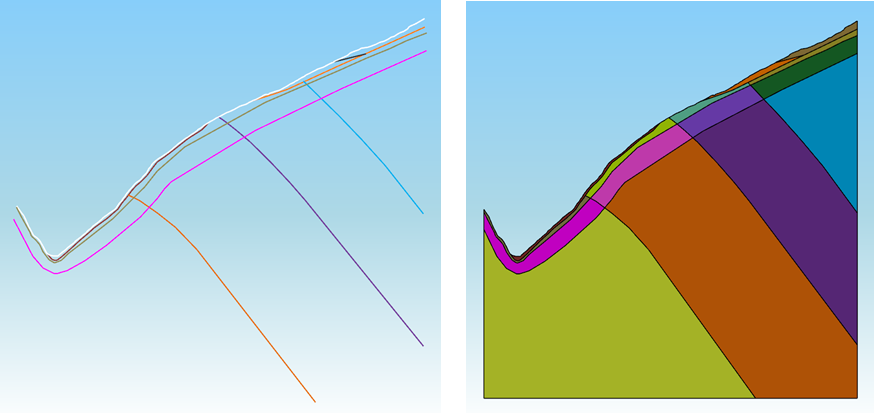
With the continuous improvement of the mechanical calculation module, the release of the new version of Jiahua Geoscience's3D geological modelingand analysis software (CnGIM_ma v5.0) has begun to be put on the agenda, and is planned to be used in the "Digital Intelligent Survey" training course held in Shenyang on August 18. The mechanical calculation module in the new version of the software is a landmark new feature. Judging from the information obtained so far, it should be the world's first integrated modeling-to-calculation software, marking that domestic software has begun to surpass international peers in this specialized direction. Practical role The essence of the big geotechnical concept is cross-disciplinary collaboration and integrated operation in engineering practice. Software suited to this needs to break through the boundaries between specialized models and realize interaction between cross-disciplinary models, so that methods from different disciplines can be integrated and applied. Even though in some industries big geotechnical engineering is still a goal pursued by geological engineers, after completing 3D geological modeling and parameter value selection, using mechanical calculation methods to review geological survey results remains part of a geological engineer's duties. CnGIM_ma v5.0 can complete the task efficiently and truly realize digital empowerment: 1) Use the deformation and failure modes revealed by numerical calculation and compare them with field phenomena to help review the mechanical rationality of the geological model, and whether the geological boundaries described by the geological model are consistent with field behavior; 2) Use the calculation results of the stability coefficient to review the degree of rationality of parameter values, so that quantitative values are consistent with qualitative judgments. Technical difficulties Model interaction is the pain point of cross-disciplinary 3D collaborative work, mainly referring to the interaction of 3D models among the three disciplines of geology, design, and calculation. The G-BIM technology pioneered by Jiahua Geoscience has realized model interaction between geology and design. The mechanical module of CnGIM_ma has removed the last barrier to cross-disciplinary interaction and cleared the technical obstacles to 3D digitalization in the geotechnical engineering field. Its difficulties are reflected in the following aspects: 1) Triangulation technology. For a 3D geological model constructed using a triangular mesh, each mesh should tend toward an equilateral triangle to meet the stringent requirements of mechanical calculation on mesh quality. The triangulation technology in 3D geological modeling software has therefore also become one of the key components of modeling technology, directly affecting the scope of application of geological models; 2) Topological intersection-cutting closure technology. Mechanical calculation is often carried out for given sections and regions in a geological model. When constructing a mechanical model, it is necessary to intersect and cut the geological model composed of triangular meshes. During 2D sectioning, scattered lines are formed (surface lines, stratum lines, fault lines, groundwater level lines, etc.); during 3D intersection-cutting, scattered geological surfaces such as terrain are formed. After intersection-cutting, these discrete geological objects need to be used to construct fully closed 2D regions or 3D envelopes according to mechanical meaning. This process is called intersection-cutting closure. Fully closed means that adjacent closed regions not only share intersection lines, but the triangular meshes of adjacent regions also share nodes on the intersection lines. The mathematical method on which topological intersection-cutting calculation relies is not the Boolean operation in the form of function intersection in BIM software, but the topological operation of discrete mesh intersection, which is more difficult. Affected by computer floating-point errors, topological intersection-cutting cannot guarantee 100% success, so it has become a veritable worldwide problem; 3) Tolerance technology. One of its important tasks is to improve the success rate of topological intersection-cutting through the accumulation of cases. It also includes technologies in multiple links such as the handling of fragmented meshes, irregular meshes, and overly dense intersection points after intersection-cutting. The uncertainty of geological bodies means that time and case accumulation are indispensable foundations for solving the problem. Figure 1: Uniform mesh vs. irregular mesh Figure 2: 2D geological map vs. material zoning calculation model after section line closure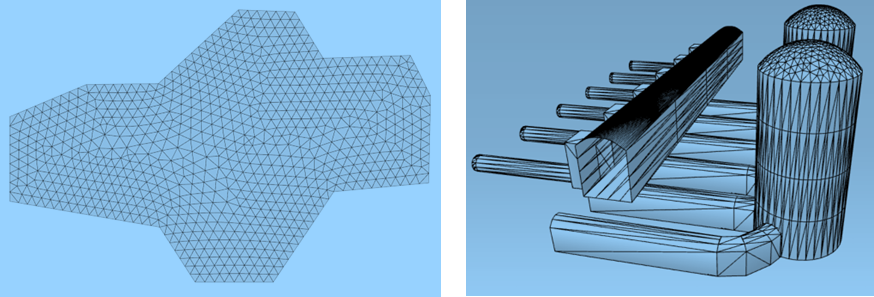
Technical features The mechanical calculation module of CnGIM_ma v5.0 supports two calculation methods: 2D limit equilibrium and discontinuous numerical methods. Each method supports two different software programs and adopts two integration modes: built-in and external. Its features are: 1) For methods of the same type, no matter which calculation software is used, the operations are completely identical, and all use engineering language, transforming high-end scientific research tools into production tools; 2) All external software support cloud computing. The calculation software is shared within the user's network scope, and queuing is supported when there are multiple users, maximizing the utilization of the calculation software. The limit equilibrium calculation of the mechanical module includes both built-in and external modes. The built-in limit equilibrium includes four methods: Bishop, Sarma, M-P, and residual thrust method, jointly developed by Jiahua Geoscience and Professor Zhang Qihua of China University of Geosciences (Wuhan); the external mode connects to RocScience's Slide. The operation commands of the built-in calculation methods and the external Slide are completely identical, meaning that Slide calculations can be completed without learning Slide.
Experts and Scholars | One of the Sixth Sichuan's Most Beautiful Science and Technology Workers — Academician He Chuan: Boring Through Mountains and Rivers, Carving Out One "Path to the Sky" After Another
下一篇Excavator Index for the First Half of 2025

2026-10-14 0 0

2026-09-28 36 0
2026-09-22 10749 0

2026-09-18 11026 0

Lize City Air Terminal Underground Main Structure Nearing Completion: Maximum Transfer Walk Under 4 Minutes After Operation

Anti-seepage Curtain for Main Lock Pit of CSCEC Port Shenqiu Double-Line Lock Project Completed on Schedule

All Pile Foundations Completed on Quanzhou Baiqi Channel
Hainan Upgrades Housing and Municipal Infrastructure

First Foundation Concrete Pour Successfully Completed for Zambia Kafue West–Muzuma 330kV Transmission Line EPC Project
Hot News

评论 (0)