"Youth is a kind of aura, and my goal is to fight on for another sixty years!" At the launch ceremony of the sixth Sichuan "Most Beautiful Science and Technology Workers," the resounding declaration by He Chuan, academician of the Chinese Academy of Engineering and chief professor at Southwest Jiaotong University, drew enthusiastic applause from the entire audience. This leader in tunnel engineering, though past sixty, still charges to the front line of scientific research—imparting new knowledge from the podium, tackling tough problems in the laboratory, and bending his back in practice in plateau tunnels, his footprints imprinted across mountains and great rivers. He always says: "Research cannot be done by sitting around theorizing; you have to go to the production front line!"
Carving Through Mountains: Cracking the "Impossible" with Intelligent Drill-and-Blast In recent years, He Chuan's footprints have frequently appeared among the lofty ridges and peaks of the plateau. As a tunnel engineering expert, he has led his team in charging at the challenge of intelligent construction of ultra-long high-altitude tunnels. In 2020, He Chuan took the lead on a National Key R&D Program project involving plateau railways, often requiring him to set foot on construction front lines above 4,000 meters in elevation. In temporarily built laboratories, he observes, discovers, and analyzes data from various rock strata; at tunnel blasting sites, wearing earplugs, he records drilling rig parameters, seeking the key to breaking the deadlock. The extreme plateau environment makes the traditional drill-and-blast method extremely difficult: low temperatures and oxygen deficiency halve manual efficiency, mechanical failures occur frequently, and construction safety and quality face severe challenges. Facing these world-class problems, He Chuan's team developed a fully-process mechanized intelligent construction system. This revolutionary technology uses artificial intelligence to identify geological conditions in real time, automatically directs machinery operations, achieves precise blasting control, and can also monitor construction safety throughout the entire process. The application results are inspiring: construction efficiency increased by 30%, and labor input reduced by 50%. Workers in the tunnel, with ice chips splashing around them, give a thumbs-up: "Now 25 people can finish the work of 50, and progress is 30% faster." Academician He Chuan inspecting conditions at a tunnel construction front line In the history of China's tunnel construction advancing from manual shoulder-carrying to the roar of machinery, the names of countless builders are engraved, and He Chuan is an important one among them. Thirty years ago, when he went to study in Japan, China's shield tunneling technology landscape was almost blank. At Waseda University in Japan, he keenly locked onto the shield tunneling direction and studied the world's advanced construction technologies. In 2000, He Chuan returned after completing his studies to teach at Southwest Jiaotong University. At this time, China's urbanization process was accelerating. In the wave of subway construction, shield tunneling technology became a key move for opening up the underground transportation arteries of cities. In 2004, Chengdu's subway construction encountered obstacles, stuck at a special water-rich sand and gravel stratum—the area had high gravel content, high strength, and a high groundwater level, and shield tunneling advanced only 50 meters per month, with cutting tools wearing down like a blunt knife chopping bone. "We can't just go at it blindly!" He Chuan conducted on-site investigations and, after repeated research with his team, overturned the traditional "crushing-first" approach and innovated a method of "discharging first, crushing as auxiliary." At the same time, the cutter configuration was changed from single-edge or multi-edge disc cutters focused solely on crushing gravel to a combination of cutters with multiple functions. As he put it: Change it! The machinery must be made to "obey." After continuous optimization of the construction method, the tunneling speed increased substantially, with monthly progress rising to more than 300 meters. The adjustment results were quickly applied on a large scale throughout Chengdu; at the peak in 2018, 173 shield tunneling machines were rumbling beneath Chengdu. Today, the shield tunneling method has become the preferred method for urban subway construction in China. Educating People: Writing Papers Matters, but Solving Real Problems Matters More Deeply cultivating the engineering front line while long rooted at the forefront of education and teaching has given He Chuan profound insight into talent cultivation. He has always upheld a principle: not only use technology to "split open the mountains," but also use the way of a teacher to "ignite sparks." When supervising graduate students, he often emphasizes: publishing papers in journals is important, but engraving them into engineering practice is even more important! This commitment to education—"looking at scores but not only at scores"—is the foremost principle of his teaching. At every start of the semester when welcoming new students, He Chuan always sets aside a full hour to dig deep into students' interests: "Do you like intelligent equipment or geotechnical analysis?" Based on everyone's answers, He Chuan "customizes research topics" for them. Today, many students on He Chuan's team still clearly remember their supervisor's first question, and this "personalized training" has also expanded their room to maneuver. Academician He Chuan conducting research during tunnel construction He Chuan has extremely high teaching requirements, which also run through textbook compilation. While chief-editing the textbook Underwater Tunnels, he took his manuscript to the construction sites of the Nanjing Yangtze River Tunnel and the Shiziyang Tunnel, pulling construction workers into section-by-section discussions and soliciting opinions. "Textbooks must stand the test of time!" He repeatedly reminded his team. Even when a rainstorm hit during exploration for the Guangzhou-Shenzhen-Hong Kong High-Speed Railway, he unhesitatingly stepped into the mud and jumped down into the foundation pit to demonstrate instrument operation for students on site: "Look, this is how you measure data accurately." He knows well that true knowledge comes from practice and must also return to practice. This profound understanding that scientific research cannot stop at "paper" also extends to his judgment of the value of research. In He Chuan's view, if scientific research results remain only on paper, they will ultimately become "stale fruit." Research must serve society, and the transformation of results is the key to opening up the "last mile" of innovation. However, for a long time, the low conversion rate of scientific and technological achievements has been a "chronic disease" constraining scientific and technological innovation. How to solve this problem? Sichuan took the lead nationwide in launching reform of the ownership system for job-related scientific and technological achievements. This major original reform, which originated at Southwest Jiaotong University, directly targets the pain points of transforming scientific and technological achievements. He Chuan, then dean of the Science and Technology Development Research Institute of Southwest Jiaotong University, was one of the key drivers of this reform. Through his and his colleagues' efforts, the milestone "Provisions of Southwest Jiaotong University on Patent Management" (the "Nine Articles of Southwest Jiaotong University") was issued, granting teachers 70% ownership of patent transformation, and opening China's property rights reform 2.0 era. He Chuan guiding students in conducting experiments He Chuan is not only a promoter of reform but also a practitioner of achievement transformation. He actively uses university platforms to transform his own scientific research achievements into real productive forces. The intelligent monitoring technology for long tunnels and tunnel groups developed by his team has been widely applied in nearly 20 provinces (autonomous regions and municipalities) across the country. The expressway tunnel group operation monitoring system they developed is currently conducting online monitoring of more than 2,000 tunnels, becoming a vivid example of scientific research achievements directly serving society. He Chuan's acceptance speech: This is both an honor and a responsibility. When science and technology thrive, the nation thrives; when science and technology are strong, the country is strong. Self-reliance and self-strengthening in science and technology are the foundation of a strong nation and the key to security. As a science and technology worker, I will always keep in mind the responsibility and duty on my shoulders, vigorously carry forward the spirit of scientists, continue to anchor my life goals and life plans to the great cause of the motherland, be brave in innovation, devote myself to research, and together with the vast number of science and technology workers, write papers on the land of the motherland, continuously contributing to the development of new quality productive forces and the realization of high-level self-reliance and self-strengthening in science and technology.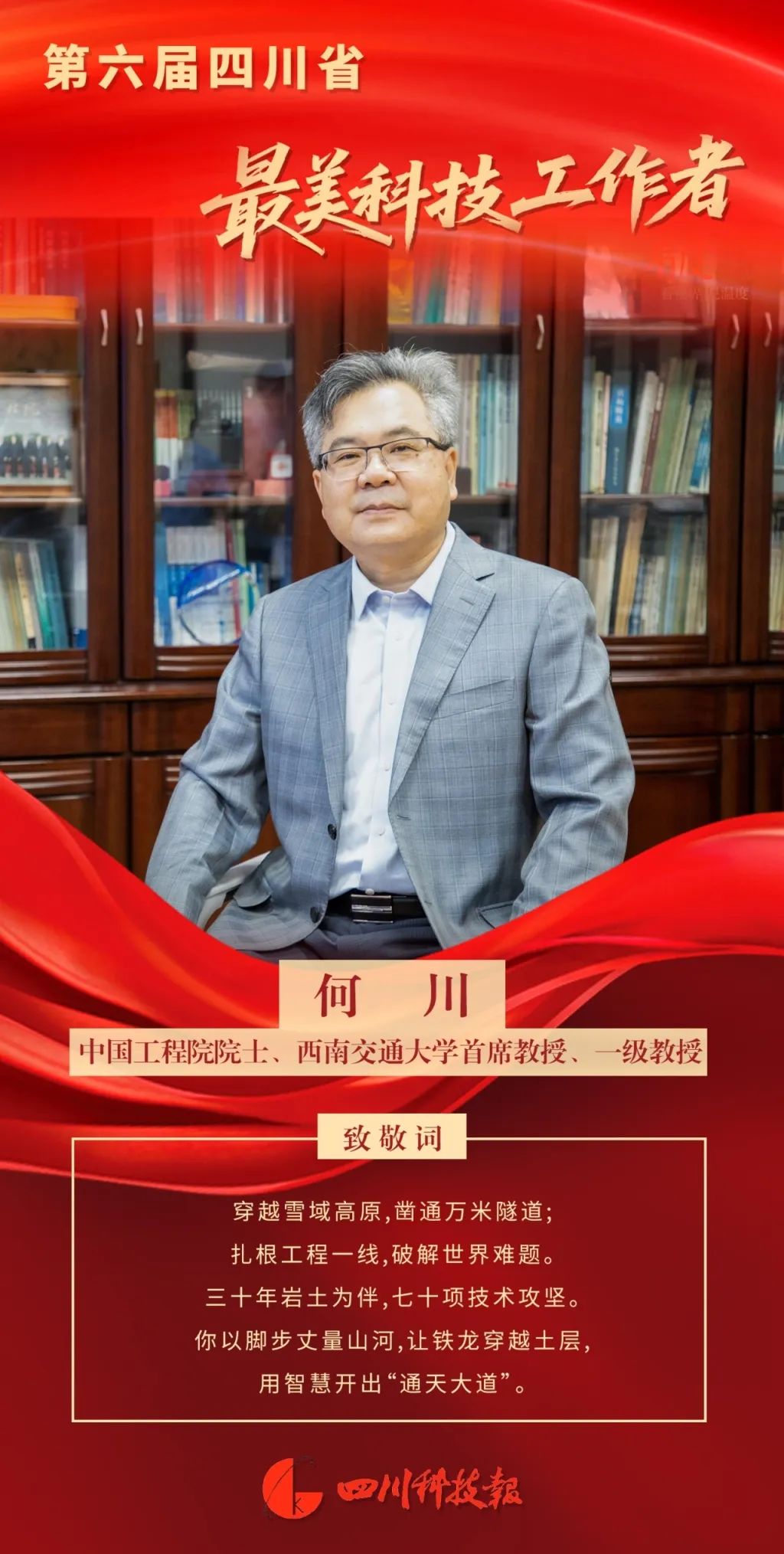


Innovative Technology | New Alliance Patent: Clamping-Press Static Anchor Pile Technology
下一篇New Product Recommendation | The World's First 3D Geological Modeling Software Supporting Mechanical Calculations, CnGIM_ma v5.0, Is About to Be Released

2025-10-23 13791 0

2025-10-20 12644 0

2025-10-20 12987 0

2025-10-13 13395 0

Lize City Air Terminal Underground Main Structure Nearing Completion: Maximum Transfer Walk Under 4 Minutes After Operation

Anti-seepage Curtain for Main Lock Pit of CSCEC Port Shenqiu Double-Line Lock Project Completed on Schedule

All Pile Foundations Completed on Quanzhou Baiqi Channel

Hainan Upgrades Housing and Municipal Infrastructure

First Foundation Concrete Pour Successfully Completed for Zambia Kafue West–Muzuma 330kV Transmission Line EPC Project
Hot News

评论 (0)