Recently, the Xinjiang section of the Hami–Chongqing ±800 kV UHV DC transmission line project, part of the "Xinjiang Power Transmission to Chongqing" UHV project, achieved full line completion. The project is one of the 102 major projects identified in the national "14th Five-Year Plan" development plan and an important component of the "Xinjiang Power Transmission to Chongqing" project.
The Hami–Chongqing DC line starts in Hami, Xinjiang, and terminates in Yubei District, Chongqing. As the third DC channel for "Xinjiang power transmission outward," the line has a total length of approximately 2,290 kilometers, passing through five provinces: Xinjiang, Gansu, Shaanxi, Sichuan, and Chongqing.
Fujian Institute is responsible for the design of Construction Section 2-2 of the Hami–Chongqing ±800 kV UHV DC transmission line project, with a line length of 111.17 km and 222 new towers. The line is erected as a single-circuit bipolar configuration, passing through Yizhou District, Hami City, Xinjiang.
To date, Fujian Institute has participated in all Xinjiang UHV outward transmission projects, including four projects: Hami–Zhengzhou, Zhundong–East China, Hami–Chongqing, and Xinjiang Power Transmission to Sichuan.
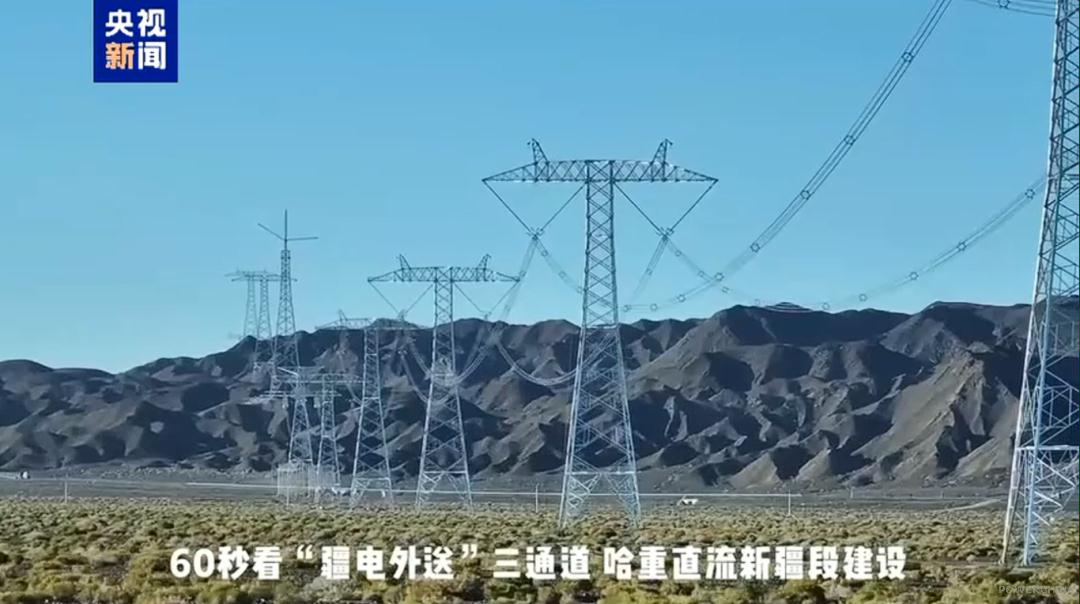
▲ CCTV news report
The entire section is located in an uninhabited area, with summer high temperatures of 43.9°C, winter low temperatures of -35°C, an average of up to 200 windy days per year, and an average of more than 10 sandstorm days per year.
"The local strong winds and severe cold weather have brought great construction difficulties. To address this, we adapted measures to local conditions and proposed structural anti-erosion and durability solutions, further enhancing project management levels and the capacity for innovation and efficiency creation," explained Ma Qin, the project chief designer, on site.
To address the corrosion problem of saline-alkali foundation soil, Fujian Institute for the first time piloted the application of silane impregnation anti-corrosion technology, using wrapped cast-in-place pile skirted excavated foundations in strongly corrosive areas to replace conventional large-excavation foundations. This effectively solves the shortcomings of traditional anti-corrosion coatings, such as low efficiency and complex procedures, and once again optimizes the full-process mechanized construction of foundation anti-corrosion for UHV lines.
After 11 months of intensive construction, the Xinjiang section achieved full line completion, the first among the five provinces along the entire project.
It is expected to be put into operation in May 2025. By then, Xinjiang will be able to transmit more than 36 billion kWh of electricity to Chongqing annually, meeting one quarter of Chongqing's electricity demand, replacing 6 million tons of coal consumption per year, and reducing carbon dioxide emissions by 16.5 million tons, continuously delivering a steady flow of green power to the local area.
Sinohydro Bureau 3 Qingdao Guanlu Reservoir Project Receives Banner for Rural Road Repairs
下一篇Sichuan-Tibet Power Grid Interconnection Project Has Cumulatively Transmitted 8.7 Billion kWh of Electricity Over 10 Years
2026-09-28 1157 0
2026-09-24 10586 0
2026-09-23 10714 0
2026-09-22 10808 0

Lize City Air Terminal Underground Main Structure Nearing Completion: Maximum Transfer Walk Under 4 Minutes After Operation

Anti-seepage Curtain for Main Lock Pit of CSCEC Port Shenqiu Double-Line Lock Project Completed on Schedule

All Pile Foundations Completed on Quanzhou Baiqi Channel

Hainan Upgrades Housing and Municipal Infrastructure
First Foundation Concrete Pour Successfully Completed for Zambia Kafue West–Muzuma 330kV Transmission Line EPC Project
Hot News

评论 (0)