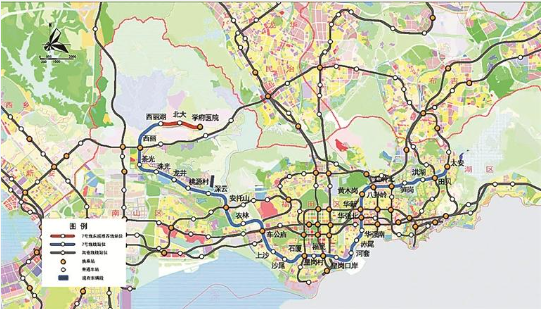
Schematic Diagram of Shenzhen Metro Line 7 and Phase II (Eastern Extension)
Recently, the right line of the section from Beida Station to Xilihu Station of the Shenzhen Metro Line 7 Phase II (Eastern Extension) project was successfully holed through. At this point, the shield tunneling sections of the Metro Line 7 Phase II (Eastern Extension) project have been fully holed through, successfully completing yet another important milestone node in the process of achieving the full-line opening task for this contract section.
Beida Station is located on the east side of the intersection of Lishui Road and Chunyuan Road, laid out in an east-west direction along Lishui Road, with a total of 3 entrances and exits. The station is 241 meters long, with a standard section width of 20.6 meters and a foundation pit depth of approximately 18.82 meters, constructed using the semi-covered excavation method; Xuefu Hospital Station is located at the intersection of Liuyin Road and Youlan Road in Nanshan District, arranged in an east-west direction along Liuyin Road, with its west end serving as the shield launching station. The station has a total length of 361.6 meters, a width of 20.7 meters and a foundation pit depth of 20.2 meters, constructed using the open-cut sequential excavation method.
Since entering the site, the participating units have completed traffic diversion, utility pipeline relocation, greening relocation and other work, carried out advance technical tackling, and held multiple special meetings to jointly resolve technical difficulties such as diaphragm wall trenching in high-strength boulder strata and the optimization of 10 kV power and communication pipeline relocation. They organized on-site construction operations in an orderly manner and successively overcame many difficulties including a narrow construction site, complex main structure and coordination work, laying a solid organizational, technical, safety and quality foundation for the smooth capping of the station's main structure.
Among these, the left and right shield tunnels successively passed beneath complex sections including the Chunyuan Road rainwater box culvert, the White Swan Lake section, long-distance boulder groups and fully weathered coarse-grained granite sections, and the ultra-shallow-buried Swan Pond section, presenting enormous challenges for shield tunneling construction. To effectively implement measures such as the zoo land occupation, boulder pretreatment, pumping and drainage for passing beneath the lake, and for the ultra-shallow-buried section the cofferdam water-stop curtain + uplift piles + anti-floating cover slab + lakebed cement mixing pile reinforcement, the project team held multiple special meetings and actively strengthened external communication and coordination, laying a solid foundation for shield tunneling construction.
The Shenzhen Metro Line 7 Phase II (Eastern Extension) route starts from Xilihu Station, the terminus of Line 7 Phase I, runs along Lishui Road and Xueyuan Avenue, and ends at Xuefu Hospital Station. The route is approximately 2.28 kilometers long, with 2 stations, all constructed underground. The stations are Beida and Xuefu Hospital. Among them, Xuefu Hospital Station will interchange with Line 27 (planned).
As of now, among the entire line's works, the installation and decoration of Beida Station is 20% complete; the main structure of Xuefu Hospital Station is 100% complete; and the shield tunneling sections are 100% complete.
It is expected that after completion in 2025, Line 7 Phase II (Eastern Extension) will connect the Shenzhen-Hong Kong Cooperation Zone with the Xilihu International Science and Education City. It will not only effectively enhance internal connectivity within Nanshan District, but also support the construction of the Comprehensive National Science Center, supplement the rail network coverage in the region, and make travel for residents in the Shenzhen University General Hospital area more efficient and convenient.
Harbin Metro Line 3 to Achieve Loop Operation by Year-End
下一篇2024 List of Key Projects in Sichuan Province Announced!

2026-10-18 0 0

2026-10-18 0 0

2026-10-17 0 0

2026-09-23 10598 0
Lize City Air Terminal Underground Main Structure Nearing Completion: Maximum Transfer Walk Under 4 Minutes After Operation
Anti-seepage Curtain for Main Lock Pit of CSCEC Port Shenqiu Double-Line Lock Project Completed on Schedule
All Pile Foundations Completed on Quanzhou Baiqi Channel

Hainan Upgrades Housing and Municipal Infrastructure
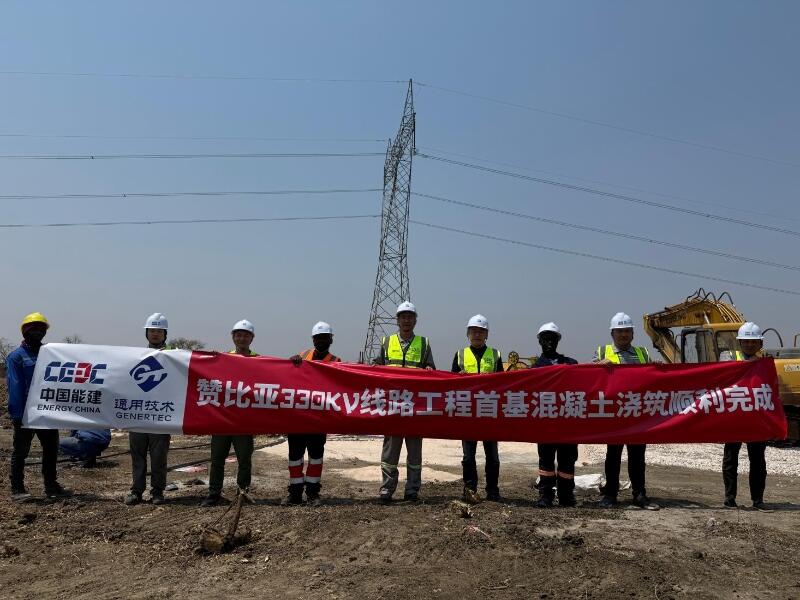
First Foundation Concrete Pour Successfully Completed for Zambia Kafue West–Muzuma 330kV Transmission Line EPC Project
Hot News

评论 (0)