XCMG Smart Manufacturing 4.0
With 'innovation-driven, intelligent manufacturing' as the development主线, in recent years, XCMG has formulated the 'Smart Manufacturing 4.0' strategy, establishing a 'product view, manufacturing view, user view, and ecosystem view' that keeps pace with the intelligent era. It is highly industry-specific, reflecting the intelligent manufacturing of the equipment manufacturing industry, highlighting the characteristics and attributes of XCMG's intelligent manufacturing, and demonstrating its pragmatism, advanced nature, and growth potential.
Recently, China Industry and Information Technology magazine published an article titled '5G Technology Ignites the Spark of Smart Manufacturing,' providing an in-depth report on XCMG's 5G construction, technological innovation, and the 'XCMG Smart Manufacturing 4.0' strategy.
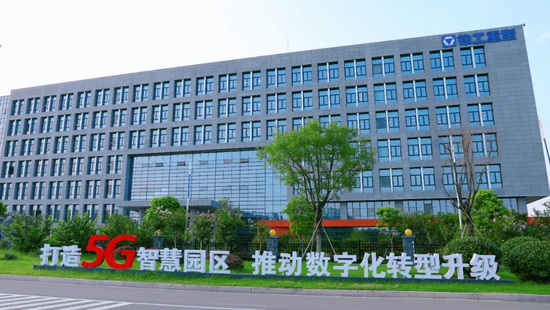
What Does a True Smart Factory Look Like?
In XCMG's Crane 5G Smart Industrial Park, nine intelligent production lines and three smart workshops have been built. This layout has significantly improved production capacity, quality control, efficiency, and other aspects.
In the workshop, robotic arms operate efficiently and methodically, and robots move skillfully... In the park, through the empowerment of 5G technology and the use of big data, 'the Internet of Everything' is realized. Equipment, product vehicles, logistics vehicles, various materials in the production process, current inventory status... all are clearly visible. The blueprint for the integrated application of 5G in complex industrial scenarios has already advanced XCMG Smart Manufacturing to 4.0.
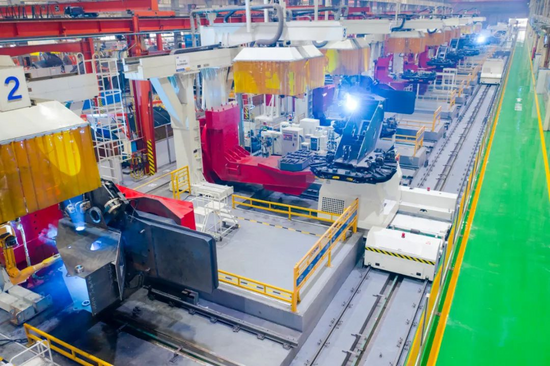
In promoting intelligent manufacturing, XCMG has adopted a 'one body, two wings' strategy.
The 'one body' refers to the systematic work of intelligent manufacturing, namely the overall layout relying on the 5G network with large bandwidth, low latency, wide connectivity, and high reliability. One of the 'two wings' is automation, including the automation upgrade of traditional equipment and the transformation of production lines; the other 'wing' is digitalization, that is, connecting all equipment networking systems, advanced planning and scheduling API systems, quality management systems, etc., and aggregating all data to the central control command center. These visible production lines and invisible digital systems present the appearance of a future smart factory before our eyes.
The Power of 5G
Taking XCMG's 'world's largest crane production base' as an example, here, the 5G network is exerting its greatest advantage—the factory is becoming increasingly unmanned and automated, and the synergy between equipment is growing stronger. It is worth mentioning that such a 5G industrial intranet is not the traditional Internet. Since 5G base stations are built inside the factory, all terminals directly transmit data to the 5G base stations, and the entire process does not need to go through the external Internet, so traffic costs and expenses are not high.
CCTV's Xinwen Lianbo Headline Focuses on XCMG's 5G Network Remote Control Technology for Cranes
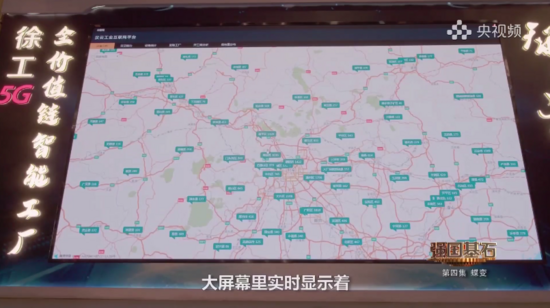
5G technology will achieve full data connectivity from the three-level production lines to the entire factory, and even the entire company. All these form a matrix, and the data in the matrix is aggregated to the central control center. The aggregation of massive data is actually to accomplish three things—
First, early warning. Track task progress and completion quality, obtain indicator parameters through data analysis, and realize early warning functions; second, real-time alarm. When equipment fails, relevant information is fed back from the production line, and the back-end departments respond quickly and schedule; finally, comprehensive prediction. That is, combining internal and external data to predict macro trends such as market trends. This is the most technically demanding function and the direction for the next step of 5G and related technologies. 'The key is that the realization of these functions has greatly improved production efficiency and can achieve maintenance without stopping work,' pointed out Li Zhongfu, Director of the Information Management Department of XCMG Heavy Machinery.
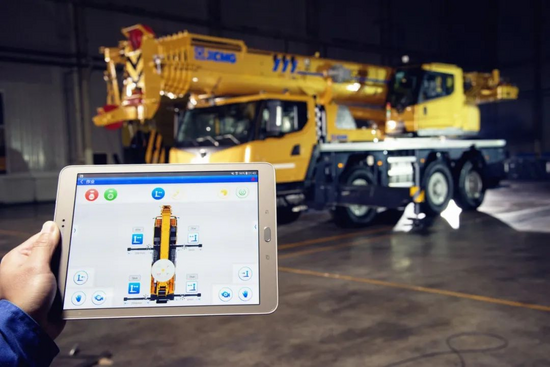
In terms of 5G+ manufacturing application scenarios, through the 5G network covering the entire factory, data is directly obtained from core equipment. The most important significance is the ability to understand the status of equipment in real time. 'When new equipment in the factory needs to be networked, the traditional approach is to spend at least a week on comprehensive wiring, while the 5G network can be directly connected, enabling rapid network access within a day,' Li Zhongfu emphasized the advantages of 5G.
'In terms of quality control and process improvement, XCMG based on '5G+ machine vision' technology has discovered problems such as wrong assembly and missing assembly in the assembly process, achieving online quality control,' summarized Zhou Hualong, a R&D engineer at XCMG Heavy Machinery, based on machine vision application examples.
Zhou Hualong pointed out: 'XCMG independently developed a new product test and verification platform based on 5G technology to strictly test and verify the performance and reliability of cranes to ensure product quality. Through this platform, 4K high-definition images of crane complete machines, systems, components, etc. in the XCMG comprehensive test site 20 kilometers away from the headquarters can be remotely viewed, and the entire test process can be managed in real time, monitoring data, tasks, progress, problems, etc., allowing the entire test and verification work to be carried out in an orderly and efficient collaborative manner.'
In terms of 5G+ market application scenarios, when users report equipment failures, based on the need for fault analysis, using 5G+AR/VR technology, data is transmitted to the cloud in real time through AR glasses, which can interact bidirectionally like a mobile phone. Technical personnel at the headquarters, through the monitoring system, can analyze specific parameters and troubleshoot as if they were in front of the crane, achieving zero-distance rapid service. At the same time, by tracing historical data, some faults that are difficult for users to describe can be discovered. Technical personnel can recall data, restore the on-site situation, and then solve the problem.
The application of intelligent 5G technology ensures the leading nature, consistency, reliability of products, as well as iterative technology updates, thereby completely getting rid of the vicious cycle of 'price reduction, cost reduction, quality reduction' in market competition.
XCMG Smart Manufacturing 4.0
As a microcosm of XCMG Smart Manufacturing 4.0, the '5G+ Industrial Internet Integrated Application Project' was launched as early as 2019.
The project relies on XCMG Heavy Machinery's super-large tonnage crane industrial base and is committed to building the first 5G end-to-end slicing and edge computing combined smart park private network in the construction machinery industry. Integrating enterprise 5G+ R&D, 5G+ manufacturing, 5G+ market, 5G+ park management, 5G+ full product construction and other business application needs, comprehensively applying key technologies such as machine vision, artificial intelligence, high-precision indoor positioning, AR/VR for specific needs of the Industrial Internet, creating more than 30 typical '5G+ Industrial Internet' application scenarios, and building a smart industrial park and a 5G full value chain smart factory.
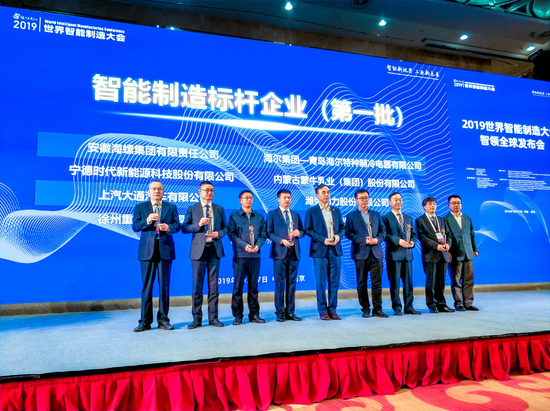
Where does XCMG Smart Manufacturing 4.0 lead? Fu Simin, Director of the Information Management Department of XCMG Machinery, answered: 'The 5G+ Industrial Internet Integrated Application Project is based on XCMG's most complete, most complex, and most typical industrial scenario requirements and parameter settings. Together with China Unicom and Huawei, we have jointly developed a batch of industrial-grade 5G modules and 5G terminals, formed a batch of applicable transformation plans for 5G production line equipment and 5G construction machinery, promoted 5G+ Industrial Internet technology research and reserves, and formed standards or white papers for 5G industrial modules and equipment, 5G industrial control (CAN, PLC), 5G park private networks, and 5G industrial slicing networks.'
'Using the collaboration of '5G+ Industrial Internet', a large number of equipment produced by different manufacturers, different brands, and different eras can all be connected on the integrated platform, achieving maximum interoperability between equipment,' Li Zhongfu introduced. This not only enables real-time monitoring of production equipment operation data, making capacity scheduling more precise and reasonable, greatly improving production efficiency, but also tracks and returns product parameters, providing remote diagnosis services for customers, greatly enhancing the company's market reputation.
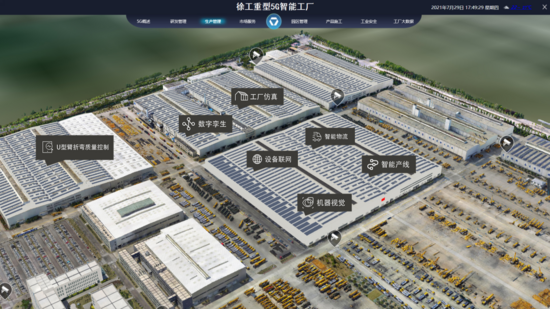
Not only real-time equipment monitoring and online product diagnosis, at XCMG Heavy Machinery, the integrated application of '5G+ Industrial Internet' is constantly sparking more 'smart sparks'—through the 5G private network, new product debugging sampling data and debugging images are transmitted back in real time and analyzed online, effectively assisting product R&D and design; with new technologies such as artificial intelligence and AR/VR, intelligent analysis and decision-making are realized, making management more scientific and precise... The integrated application of '5G+ Industrial Internet' has created a brand-new industrial production and manufacturing and service system.
Reducing the feedback rate of ultra-early adjustment faults of products by 35%, increasing the 24-hour completion rate by 2 percentage points, and increasing the first-time quality inspection pass rate by 5%... For the benefits that 5G can bring, Li Zhongfu provided specific data.
XCMG independently developed 5G-based crane remote debugging technology. Through the 5G network, debugging personnel can remotely control the test vehicle at the central control center and carry out debugging tasks for crane lifting operations. At the same time, the operating data of the test vehicle is transmitted back to the central control center in real time and drives the digital twin model for simulation analysis. Compared with traditional debugging methods, this debugging method can greatly improve the working environment and safety of debugging personnel.
Intelligent Operation
With the rapid development of clean energy, transportation, and other industries, improving crane safety and construction efficiency through intelligent operations has become an important development direction for the industry. Advanced companies in Europe and America all regard intelligent operation as a core technology key research area, but have not yet formed systematic solutions and still remain in a state of 'manpower-based, machinery-assisted'. Intelligent operation is the key for Chinese companies to continue leading in the global wheeled crane industry.
Relying on the 'industry-university-research-application' collaborative innovation model, XCMG Heavy Machinery deeply integrates informatization, intelligence, and complex equipment construction, comprehensively conquering the key technologies of intelligent operation of wheeled cranes, achieving intelligent operation, intelligent auxiliary driving, and intelligent management, proactively preventing risks and improving operation accuracy and efficiency through intelligent construction, solving the three major problems of traditional technology, and achieving a technological breakthrough from 'experience operation' to 'intelligent operation'.
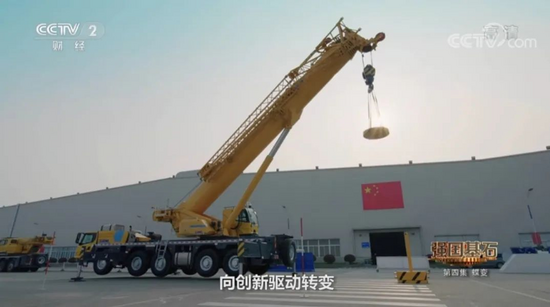
Automatic planning technology for working conditions—through automatic query and optimization of thousands of performance data of the crane human-machine interaction system, it achieves optimal working condition recommendation in as short as 3 seconds, simplifying the lifting operation process and increasing crane operation efficiency by 34%.
First-ever luffing compensation technology—through precise control of the crane luffing angle and automatic prediction of boom deflection, it effectively compensates for boom deformation caused by lifting heavy objects, ensuring that the amplitude error during lifting and lowering is less than 3%, effectively ensuring the safety of lifting operations.
Crane winch follow-up technology—through real-time monitoring of lifting status information and presetting of the winch hook position, it automatically activates and controls the winch action during telescoping and luffing, saving more than 40% of lifting time.
Auxiliary lifting technology—through drones equipped with high-definition cameras and 5G network transmission of high-definition images, details are captured and quickly fed back, equivalent to having a third-party perspective, making the entire construction process more efficient and safer.
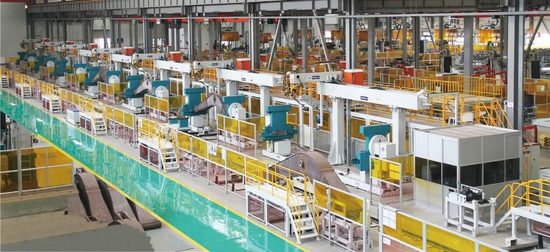
As special machinery, cranes have very high requirements for construction safety. The lifting construction environment is complex. How to find the best path among obstacles, how to achieve anti-collision, how to quickly lift into place, how to improve lifting efficiency... With the increasing popularity of 5G technology and the comprehensive coverage of 5G networks, these problems will all be solved.
@New XCMGers: Climb Higher and Make Your Youth More Brilliant!
下一篇First Lesson in Foundations: Releasing Light and Heat!

2026-09-28 1137 0
2026-09-24 10491 0

2026-09-23 10629 0
2026-09-22 10708 0

Lize City Air Terminal Underground Main Structure Nearing Completion: Maximum Transfer Walk Under 4 Minutes After Operation

Anti-seepage Curtain for Main Lock Pit of CSCEC Port Shenqiu Double-Line Lock Project Completed on Schedule

All Pile Foundations Completed on Quanzhou Baiqi Channel

Hainan Upgrades Housing and Municipal Infrastructure

First Foundation Concrete Pour Successfully Completed for Zambia Kafue West–Muzuma 330kV Transmission Line EPC Project
Hot News

评论 (0)