A bridge elevated in the city center, two main roads and two railways cross Longjin
Underground karst caves are scattered everywhere, hard rock layers defy nature
The iron army of China State Construction is stationed for long, innovative technology for pile foundations
For details of the story, listen to Xiaoliang explain clearly
……
Longyan Bridge is the first elevated bridge in Longyan urban area. It is not only a key bridge on the central axis of Longyan City, but also a landscape bridge. The main bridge has a total length of 340m and is designed as a 190+150m asymmetric single-tower double-cable-plane steel box girder cable-stayed bridge. The main tower is a "gem"-shaped bridge tower with a tower column height of 118m. The bridge crosses the Longjin River, two urban main roads, and two railway trunk lines.
 Rendering of Longyan Bridge after completion
The main tower pile foundation of Longyan Bridge has poured 13 piles since the first pile foundation was poured on April 17, 2016. The main tower pile foundation of Longyan Bridge consists of 21 piles, with a pile diameter of 2.5m, a maximum pile length of 86m, and a maximum drilling depth of 97m. The long construction time and great construction difficulty of its pile foundation are rare in China.
As the saying goes, laymen watch the excitement, experts look for the tricks
People who don't know the specific situation will ask
Why does construction take so long?
Why is it slower than other bridge pile foundation construction?
For this, Qiao Xiaoliang is willing to have a heart-to-heart talk with you
Difficulty 1: Complex and narrow surrounding environment

Plan view of the main tower pile foundation of Longyan Bridge
The middle of the above figure is the location of the main tower cap, with a total of five rows and 21 piles (pile diameter 2.5m). The north side of the cap has partially intruded into the Longjin River, the east side is adjacent to the Longxia High-speed Railway line, the south side encroaches on part of Luolong Road, and the west side is close to shops. The construction space is extremely narrow, and railway safety must be ensured (the closest point to the railway is only 15m), the traffic on the south road must not be affected, and it also bears the environmental protection responsibility for the Longjin River. That is to say, apart from the main structure space, there is very little space around for construction.
Difficulty 2: Complex underground karst cave geology, rare in China

Section view of the main tower pile foundation
The circles in the figure indicate the locations and sizes of karst caves. As can be seen from the above figure, karst caves of various sizes are almost everywhere in the entire underground space. The pile with the most karst caves is No. 21 pile, with a total of nine karst caves. The largest karst cave is the second karst cave of No. 10 pile, nearly 30m high. According to their vertical positions, these karst caves are called first-layer karst caves within 30m from the ground, second-layer karst caves within the range of 30m-60m, and third-layer karst caves within the range of 60m-100m.
The depth of the railway piles on the east side is about 40m, located between the first-layer karst caves and the second-layer karst caves. That is to say, the weight of the railway is entirely pressed on the roof of the second-layer karst caves. The piles of Longyan Bridge must all penetrate the second-layer karst caves to reach the top or bottom of the third-layer karst caves, and the roof of the second-layer karst caves must also be protected. The construction difficulty is extremely great.
The karst caves at the pile foundation locations are extremely developed, not only numerous but also with large cavities, and they are connected with the karst caves at the bottom of the adjacent Longjin River, forming an underground river. This situation is rare in China.
Difficulty 3: Hard rock layers, rock-socketed depth unique in China
 Rock samples taken from underground

Roller cones discarded after daily use
The extracted rock samples are mainly limestone and granite, either crescent-shaped in the karst cave area (extremely prone to collapse underground) or slightly weathered rock (extremely hard, with hardness reaching 115 MPa). Basically, 6 to 10 alloy roller cone drill bits are used per meter. The rock-socketed depth of large bridges in China is generally 4 to 5 times the design pile foundation. For a 2.5m pile foundation, a rock-socketed depth of only about 10m is required to meet the requirements. Because it needs to penetrate karst caves, the rock-socketed depth of this bridge's pile foundation reaches about 70m, which is 7 to 8 times the normal rock-socketed depth and is unique in China.
Many difficulties, but even more solutions
Domestic first-of-its-kind construction technology overcomes the challenges
Due to the special geological conditions of Longyan Bridge, the technical difficulty of its pile foundation construction is very great. Therefore, the China State Construction Bridge builders under the Sixth Bureau adopted the construction technology of staged drilling and staged lowering of steel casings. The construction technology is complex and is also a domestic first.
Considering the extremely developed underground karst caves, we adopted the full casing follow-up method for construction. At most, there were 6 layers of casings, with diameters of 3.6m, 3.3m, 3.05m, 2.86m, 2.65m, and 2.42m.

Spare casings First, the project department used a large-diameter drill bit to drill to the top of the first-layer karst cave, and then lowered a 3.6m or 3.3m casing to seal the first-layer karst cave and ensure safety inside the casing.
Then, a medium-sized drill bit was used to drill to the bottom of the second-layer karst cave, and a 2.86m or 3.05m casing was lowered to seal the second-layer karst cave.
Next, a drill bit not smaller than the design pile diameter was used to drill to the bottom of the third-layer karst cave, and a 2.65m casing was lowered.
Finally, a 2.5m drill bit was used to drill to the design elevation to form the hole. Considering that there are still some fissures at the bottom of the third-layer karst cave, the project department also prepared a 2.42m casing, which was套 on the reinforcement cage and lowered to the specified position. At this point, the pile can be poured with confidence.

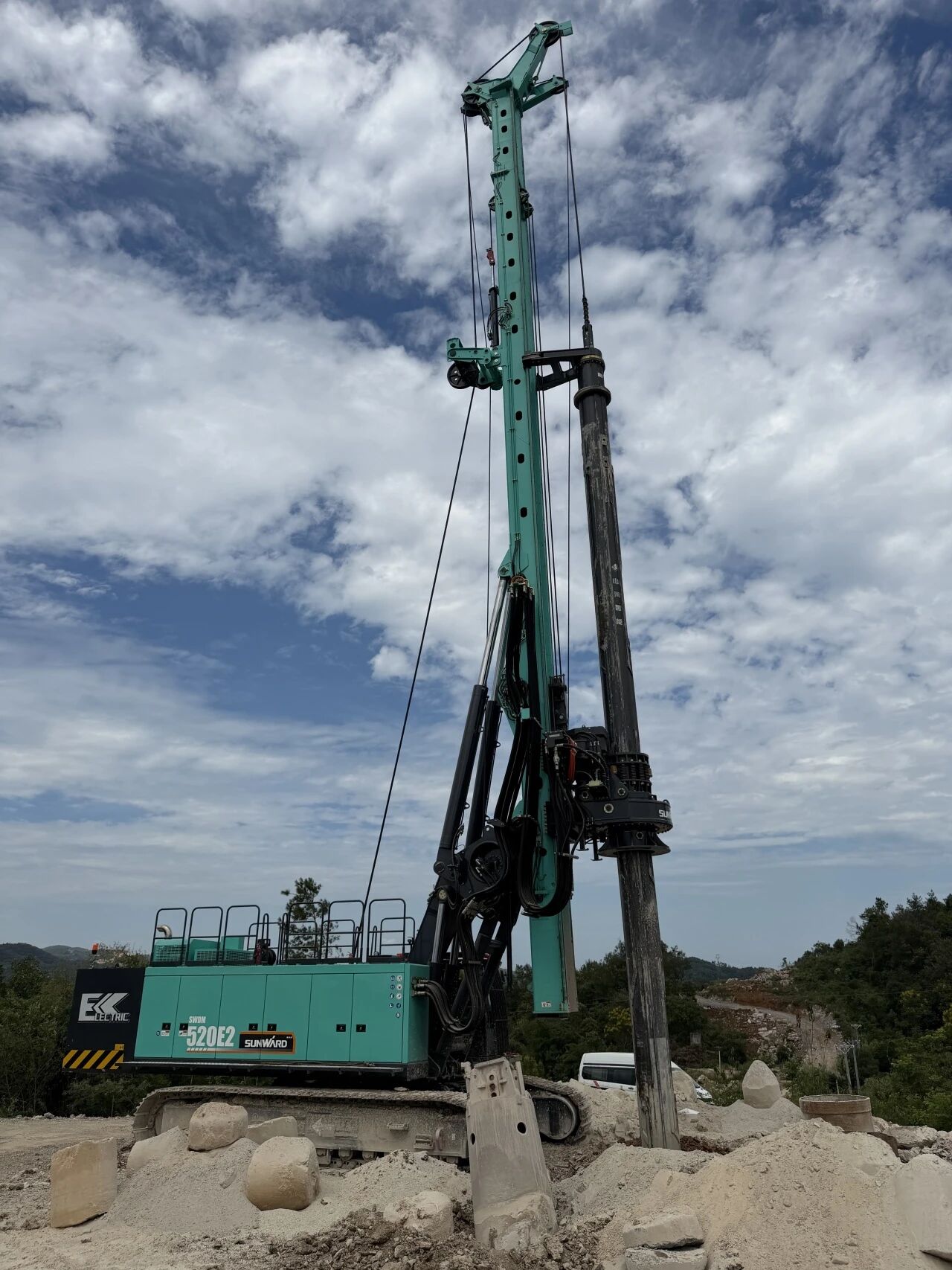
Workers are lowering the 2.65m casing According to the on-site layout and geological environment, the project introduced two CRRC 460 rotary drilling rigs and one German Bauer 460 rotary drilling rig (both are leading in China and can construct 120m deep rock-socketed pile foundations).
 Left: Bauer 460 rotary drilling rig; Right: CRRC 460 rotary drilling rig
Due to the need to lower casings of different diameters and handle different rock quality requirements, the project department prepared more than 30 types of drill bits, including drill bits of different diameters and drill bits for different functions (such as core drill bits, full-face drill bits, slag fishing drill bits, guide drill bits, etc.).
Various drill bits
Only the above technologies and equipment still cannot overcome the problem of ultra-high karst cavities. Once collapse occurs in the karst cave during drilling, it is very likely to jam the drill pipe and drill bit, making the drilling rig unable to move. Based on relevant domestic and foreign technologies, the project overcame difficulties and improved and designed 15m and 30m long roller cone bucket drills.
Awesome! Extra-long bucket drill
With this extra-long bucket drill, during the drilling process, both the upper and lower openings of the drill bit are in a safe geological environment outside the karst cave area, effectively preventing a series of problems caused by collapse.
At this point, the key challenges of pile foundation construction have been overcome. The main bridge pile foundation is planned to be fully completed in January 2018.
Closing remarks
Traveling north and south without fear of difficulties
Drilling holes and building bridges without fear of danger
With integrity and courage
Innovative technology breaks through difficulties







评论 (0)