Every morning on our way to work, we might pass the Tiyuchang Road Viaduct, cross the West Lake Cultural Square Canal Bridge, or pass through Qianjiang New City and by subway stations...
Perhaps you marvel at the beauty of this city along the way, but little do you know that behind this beauty lies the mark of Zhejiang Dacheng Construction Group. Here, we will tell you the story of Zhejiang Dacheng Construction Group, which has undergone three leaps and transformed like a butterfly emerging from its cocoon.
First Leap: Industrial Structure Adjustment
From Transportation to Road Construction
“With the changes of the times, from a planned economy to a market economy, one of the group's predecessors, Zhejiang Construction Transportation Company, faced enormous challenges, and its original transportation advantages were lost.” said Chen Guoping, General Manager of Zhejiang Dacheng Construction Group.
In 1992, the group seized an opportunity and undertook the construction of the first expressway in the province—the Ningbo Yinxian section (Dayin Township–Dazhujia) of the Hangzhou-Ningbo Expressway, thus embarking on the path of transformation and upgrading.
Hangzhou-Ningbo Expressway
However, transformation and upgrading were not easy. “The group stepped out of the transportation industry and participated in expressway construction for the first time. Due to the lack of professional talents, everyone was uncertain about the project outcome.” Chen Guoping said, equipment could be bought with money, but talents were hard to come by, so the group searched everywhere for talents.
At that time, senior executives of the group went to relevant domestic enterprises separately, asking acquaintances for help or boldly approaching strangers to recruit people. Finally, they managed to get interview opportunities, but as soon as the candidates heard that we were a new team that had never done road and bridge construction, they backed out.
“At that time, we were determined to use these large projects to quickly cultivate our own road and bridge construction talent team, so as to attract talents by building a nest.” Chen Guoping said.
While seeking talents, internal employees also hurried to make up for their lack of professional knowledge through self-study and training. Chen Guoping, a graduate of Tongji University with a major in structural engineering, was already confident about bridge construction, but found road construction somewhat tricky.
“At that time, everyone was busy with surveying and construction during the day, often for more than ten hours. At dinner, the exhausted brothers would all gather in the meeting room after dinner to study road and bridge construction textbooks and analyze drawings together.” Chen Guoping said, at that time there were nearly 50 drawings, each about a hundred pages.
It was this earnestness that supported these young men through days of physical exertion and nights of mental effort. It was this earnestness that enabled the group to successfully complete the Hangzhou-Ningbo Expressway project and accumulate rich construction experience.
Completion of Fenghua River Bridge
Looking back on past experiences, Chen Guoping was most impressed by the construction of the Fenghua River Bridge. The bridge is 1,350 meters long and was already a super-large bridge at that time.
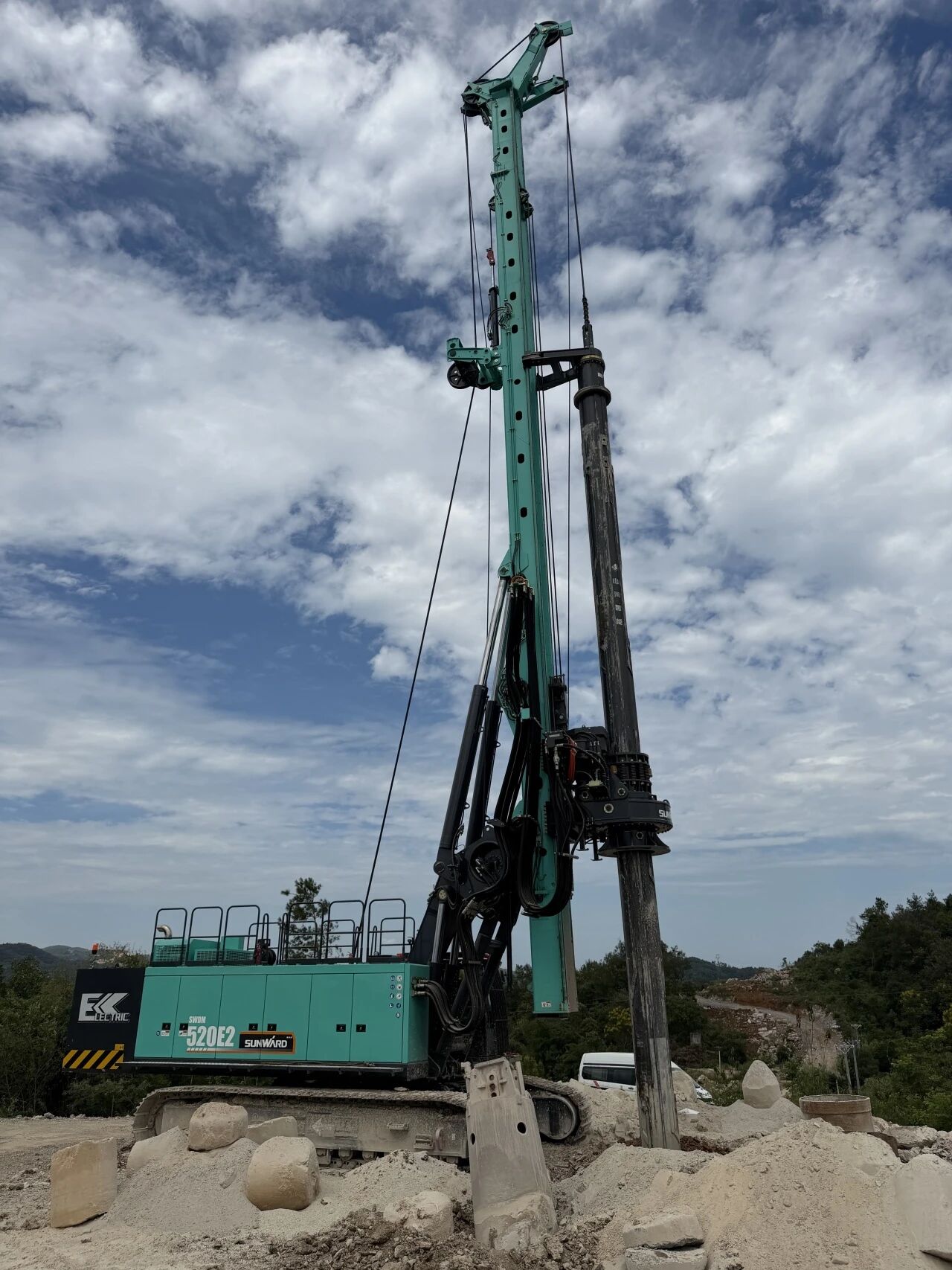
“The Fenghua River has tidal variations of six to seven meters. During pile driving, the construction pontoon rose and fell with the water level, making pile driving very difficult.” Chen Guoping said, to improve the group's hardware level, the company specially imported a rotary drilling rig from Italy, of which there were only a few in the country at that time.
“We had never used this machine before. Not to mention the supervisors, even we ourselves were uncertain.” The project team selected a test point, and as a result, it drilled a 60-meter-deep hole in 8 hours. “The machine's features are low noise and high efficiency. Leaders who came to inspect and guide our site all said, 'Hey! Your construction site is really quiet!'”.
“Dacheng people have a persistent spirit of fearing no difficulties and working hard.” Chen Guoping said, it was with this firm belief that Dacheng Group successively participated in the construction of more than 20 expressways inside and outside the province, including the Shanghai-Hangzhou Expressway and the Hefei-Xuzhou Expressway, with a total mileage of over 2,000 kilometers, paving 20.66 million square meters of road surface, and building bridges with a total length of over 23,000 meters.
Second Leap: Resource Integration
From Within the Province to Outside and Then Abroad
If 1992 was the first transformation and upgrading of Zhejiang Dacheng Construction Group, achieving industrial structure adjustment, then the second transformation and upgrading was for resource integration, and it came quickly, just seven years later.
In December 1999, Zhejiang Dacheng Construction Industrial Company and Zhejiang Machinery Construction Company, two first-class construction enterprises, were merged and restructured as a whole. With the approval of relevant provincial government departments, Zhejiang Dacheng Construction Group was registered and established.
“The merger of the two enterprises integrated technical and operational strengths, and the overall strength of Dacheng Group was greatly enhanced.” Chen Guoping said, this was another leap for Dacheng Group, exerting the effect of 1+1>2.
During this period, Dacheng Group successively participated in the construction of the Zhonghe Viaduct, Qiushi Viaduct, Fuxing Interchange, West Lake Cultural Square Canal Bridge, Desheng Expressway, and other projects.
Desheng Expressway—Municipal Gold Award

Fuxing Interchange—Golden Bridge Award
“Deep foundation pit construction is also a highlight of the group.” Chen Guoping said, Dacheng Group began large-scale bored pile underground foundation construction in the 1970s and is the earliest enterprise in the province engaged in foundation and underground engineering construction, with rich experience in underground foundation construction.
For example, in the 1980s, it built the province's first deep foundation pit project—Zhejiang Securities Building. The group has successively undertaken nearly 100 projects, including the Hangzhou Grand Theatre, Hangzhou Railway Station, the relocation and reconstruction project of the Provincial People's Congress Hall, Hangzhou Civic Center, and Qianjiang New City.
The Qianjiang New City D09 project constructed in 2011 is currently one of the deepest foundation pits in Hangzhou, with an underground wall depth of 68 meters, the deepest in Hangzhou, and a local five-story basement with an excavation depth of 28.55 meters.
With strong strength and technical force, Dacheng Group set its sights on markets outside the province and internationally, and began implementing the “going global” strategy.
Domestically, construction areas for various projects such as highways, municipal works, foundations, subways, bridges, and tunnels have covered more than 10 provinces and cities, including Guangdong, Guangxi, Ningxia, Shanghai, Jiangsu, Harbin, Chongqing, and Yunnan.
Abroad, Dacheng people have left their footprints on many overseas projects, including Cambodia's National Road 62, Road 59, and Road 6, and Sri Lanka's Airport Expressway.
Chen Guoping revealed that last year's data showed that markets outside the province and abroad accounted for more than 60% of the group's turnover.
Third Leap: Close Contact with Subways
Rich Experience and Strict Adherence to Safety Bottom Line
The third leap of Dacheng Group is related to Hangzhou Metro. In 2008, the group obtained the qualification for rail transit construction and spent more than 70 million yuan to purchase two Japanese Komatsu shield machines. In May 2009, it successfully advanced the first ring in the Hongpu Road Station–Jiubao Station section of Hangzhou Metro Line 1.
Chen Guoping introduced that as early as 1991, the group participated in the construction of the Shaanxi South Road Station of Shanghai Metro Line 1, and later participated in the construction of Shanghai Metro Lines 2 and 6, Nanjing Metro North-South Line, Phase I of Line 4, Fuzhou Rail Transit Line 1, Wuxi Metro Line 1, and other projects.

Track laying construction inside Hongpu Road Station
In the construction of Hangzhou Metro Line 1, Dacheng Construction Group undertook the shield tunnel section from Chengzhan Station to Hubin Station. Although this section is only 1,114 meters long, it is very difficult.
The shield machine started from Hangzhou Railway Station and advanced westward along Xihu Avenue toward Hubin Station, successively passing under the railway station utility tunnel, Zhonghe Viaduct, Yongjin Interchange, and other structures.
Among them, passing under the 500-meter-long Yongjin Interchange was extremely difficult because the Yongjin Interchange is a prestressed bridge with a cast-in-place structure and is sensitive to differential settlement. The close-distance underpass of the double-line shield tunnels would cause multiple disturbances to the soil layer, exerting a superimposed impact on the bridge.
Even with previous successful construction experience as support, Dacheng people did not dare to be careless at all. They established a test section to control various shield advancement parameters.
In response to the particularity of the Yongjin Interchange, Dacheng people promptly adopted special layered multiple high-pressure fracturing grouting technology to reinforce the surrounding soil within 5 meters on both sides of the bridge piles, controlling post-construction settlement after tunnel advancement was completed.
This not only avoided affecting the Yongjin Interchange, which was in operation, but also ensured that long-term train vibration loads during future operation would not cause ground settlement or soil deformation.
Safety is the bottom line of construction. “At one station on Line 1, we were responsible for the shield tunneling, and the shield route was very close to an underground sewage pipe.” Chen Guoping said, if the calculation was not precise and the soil pressure deformed or even broke the pipe, then half of Hangzhou's sewage system would be paralyzed.
Based on experience, if only steel rebar was used to support the diaphragm wall, there would be construction risks. To ensure safety, the group raised 3 million yuan on its own to change the steel rebar support to concrete support, strengthening the support system.
“As a provincial state-owned enterprise, we have a sense of mission as a state-owned enterprise. I have always required Dacheng people to take a responsible attitude toward society and the people and to achieve the best project quality.” Chen Guoping said with a smile. Because of this, Dacheng people have been involved in projects such as the Nanjing Metro North-South Line, Phase I of Line 4, Fuzhou Rail Transit Line 1, and Wuxi Metro Line 1.







评论 (0)