


GS1604T
商品详情
GS1604T
 In drilling through plastic mudstone and shale, bit balling is the biggest factor affecting drilling efficiency. Once the bit balls up, it also generates swabbing and pressure surges during tripping, which can easily trigger complex downhole accidents such as lost circulation and well kicks. In conventional drilling operations, methods such as reducing weight on bit and rotary speed and increasing flow rate are generally used to prevent bit balling, but the effect is not obvious and drilling efficiency is greatly reduced.
Through analysis and study of a large number of balled bits, Great Company designed the GS1634T anti-balling bit.
Specifications and Parameters
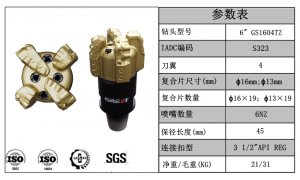
Product Features
With only 4 blades, the bit greatly increases the junk slot area
The optimized hydraulic design improves cuttings transport capacity
The double-row cutter structure reduces the number of blades without reducing the bit's aggressiveness, thereby achieving the desired rate of penetration and footage
The cutting structure adopts an optimized force-balanced design, making drilling more efficient and stable
Downhole flow field simulation technology is used to optimize nozzle layout and hydraulic design, optimizing the downhole flow field and enhancing the bit's anti-balling capability
Advanced surface hardfacing technology and materials improve the bit's erosion and wear resistance during drilling.
The new GRT series of PDC cutters improves the bit's cutting capacity, and the cutters' wear resistance and thermal damage resistance are greatly enhanced.
Additional Information
Short gauge: fast and efficient build-up in directional and horizontal well drilling.
Long gauge: improves bit stability and borehole quality.
Gauge inserts improve borehole quality.
PDC cutters with different characteristics are selected for different well types and formations to improve drilling efficiency and economic benefits.