Recently, a reporter from The Beijing News accompanied the 11th Group of the Central Work Safety Assessment and Inspection Team to Tianjin to carry out unannounced inspections and covert visits for third-quarter work safety. During the inspection in Tianjin, the assessment and inspection team found that some projects under construction had problems such as inadequate hidden-danger screening and lax on-site safety management, among which the lack of confined-space management and illegal operations in foundation pits had become common high-risk loopholes.
Confined-space operations lack management and oversight
Building construction is an industry prone to production safety accidents. On July 27, the assessment and inspection team went to the construction site of the Luan River Raw Water Pretreatment Plant Project (Section 2) in Baodi District. The project is the largest drinking-water raw-water micro-pollution pretreatment project in China, known as Tianjin Luan River water source's "super large filter element." It is constructed by Tianjin Pipeline Engineering Group Co., Ltd. and is scheduled to be completed and put into operation in December 2026.
The project consists mainly of enclosed pipeline structures, with a large number of enclosed cabins on the construction site and densely distributed confined spaces. When the assessment and inspection team arrived at the site,multiple cabins of the outlet tank were undergoing watertightness tests, but the space entrances and exits were not effectively sealed off, and no danger warning signs were posted; personnel could enter the interior at will via the stairs.
Confined spaces tend to accumulate toxic and harmful gases, causing oxygen-deficiency suffocation and poisoning casualties. Experts from the assessment and inspection team introduced that, according to the management measures for confined-space operations, the mandatory procedure of "ventilation first, testing second, operation last" must be implemented. However, the project's confined space (outlet tank) neither had warning signs set up at risk points nor retained control materials such as operation approval and gas testing, leaving a safety blind spot of missing management and oversight. According to the relevant provisions of the Guidelines for Determining Major Production Safety Accident Hidden Dangers in Water Conservancy and Hydropower Projects, this situation constitutes a major accident hidden danger. The assessment and inspection team required the construction unit to fill in the gaps in management and control across the entire chain of confined-space identification, work permit approval, emergency rescue, and routine risk inspection.
Similar problems also appeared at the construction site of the Jin-Cang Expressway Reconstruction and Expansion (from Jingwang Road Toll Station to Jiuxuanzha Section). On July 30, the assessment and inspection team found at the concrete mixing station of the project that the sunken machine cabins of the material conveyors at the two mixing stations had not been identified and documented as confined spaces, nor had safety warning measures been set up, so they could not serve as risk reminders, which did not comply with the relevant provisions of the Safety Technical Code for Confined Space Operations.
"Whether for equipment maintenance, cleaning up scattered sand and gravel, or dust management, these two underground cabins should be managed as confined spaces. Once a problem occurs under certain conditions, it will be very troublesome." The assessment and inspection team required the construction party on site to set up risk warnings and complete rectification work such as the layout of confined-space signs as soon as possible, so as to consolidate safety control responsibilities throughout the entire process.
Construction plans and on-site reality are "two separate things"
On July 29, the assessment and inspection team went to inspect the Phase II plot of the residential project in the Xiyingsheng urban renewal industry-city integration area in Nankai District. Warning slogans such as "Eliminate accident hidden dangers, build a solid safety defense line," "Don't fear tight control for a thousand days, only fear slackness for a moment," and "Come to work happily, go home safely" could be seen everywhere on the construction site. A QR code for reporting safety hidden dangers was also posted at the entrance, making it convenient for workers to report hidden-danger information at any time.
However, during the on-site inspection, experts from the assessment and inspection team found serious defects in the basket-type screw scaffold on the north side of Building 7. After the cantilever steel beams were installed, they undulated noticeably, and some steel beams had already shown end settlement without any external load, which did not meet the levelness requirements of the demonstrated special plan.
"The cantilever steel beams have been installed crookedly. How can the scaffold be installed level later? How can the load be evenly distributed? The entire surface is uneven, forming big waves. The front ends have already sunk and are drooping. This is definitely not acceptable." Experts from the assessment and inspection team stated that the formed quality of the scaffold did not meet the requirements of the special plan, and the problems and hidden dangers were prominent. The assessment and inspection team required the construction unit to rectify the cantilever steel beams, and only after joint acceptance by all participating parties could the next step of work continue.
During the inspection, experts from the assessment and inspection team found that the project also had violations in foundation pit management. According to the requirements of the project's special plan, the excavation depth of the foundation pit layer by layer should not exceed 1.5 meters, but on site some areas were excavated to a depth of more than 4 meters at one time. "Is this how you excavate? Generally it is 1.5 meters, not more than 2 meters, but this exceeds 4 meters." The east and north sides of the project are adjacent to multiple existing residential buildings, but among the 39 inspection points set up for settlement and deformation monitoring of surrounding buildings, 25 points had problems and hidden dangers such as damage, failure, and inability to conduct normal monitoring.
In response to the above problems, the assessment and inspection team has provided on-site feedback to relevant departments and enterprises in Tianjin, requiring strict implementation of the production safety responsibility system, comprehensive screening and rectification of similar hidden dangers, placing the safety of frontline workers in a prominent position, strictly implementing various regulatory measures, and safeguarding the bottom line of engineering safety.
(Source: Zhengshier)
Reposted from: Zhengshier
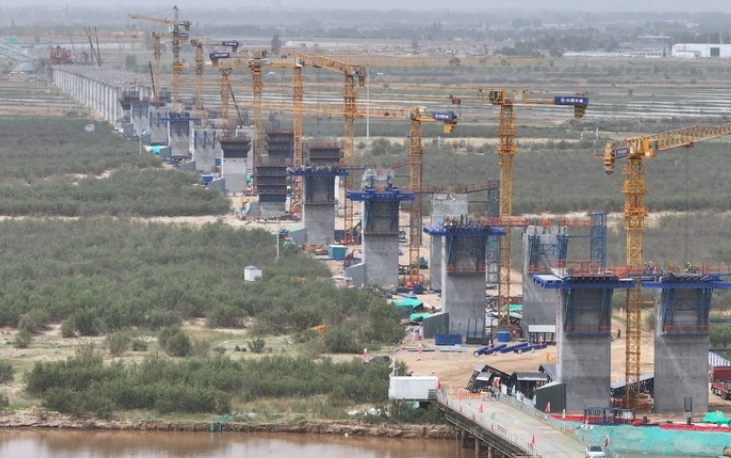
Pile Foundation Construction of Xuan'en Bridge Lays a Solid Foundation for People's Livelihood
下一篇Gao Wensheng, Director of the Institute of Foundation Engineering at China Academy of Building Research, Led a Team to CCCC Fourth Harbor Engineering Design Institute for Technical Exchange

2026-10-14 0 0
2026-09-28 39 0
2026-09-22 10755 0

2026-09-18 11026 0



评论 (0)