Recently, the No. 4 Bridge project of the Laheq Island Link Road and Sea-Crossing Bridge Project along the Saudi Red Sea coast reached a key milestone, as two pile-beam integrated machines — "Red Sea Vision No. 1" and "Red Sea Vision No. 2" — began closure construction. The two all-red machines stand aloft, one to the south and one to the north, carrying out multiple processes such as pilot hole drilling, pile driving, and beam erection continuously on the same platform, greatly accelerating the construction pace and improving operational efficiency.
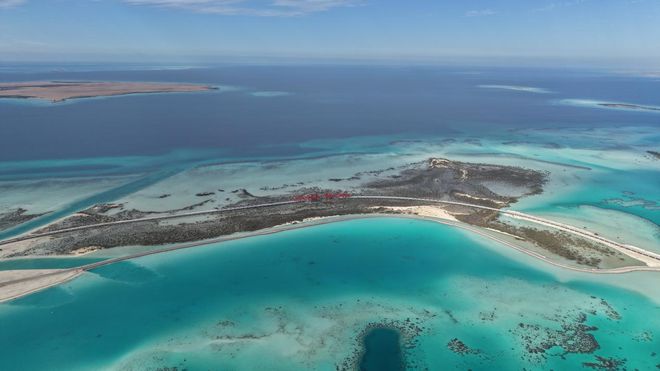
With the support of the new intelligent bridge-building equipment, bridge construction has not only achieved "China Speed" but also effectively protected the local mangroves, realizing a harmonious unity of engineering construction and ecological protection.
The project is contracted by China Harbour Engineering Company and implemented by CCCC Fourth Harbor Engineering Co., Ltd., and is an important transportation artery for Red Sea tourism development. Among it, the key section of the 2.17-kilometer mainline bridge needs to cross about 30,000 square meters of mangrove area. If constructed in the traditional way, whether by erecting steel trestles or using pile-driving vessels, disturbance to the ground surface and ecology would be inevitable. Facing this challenge, the project team innovatively proposed the construction concept of "moving from water to air" and independently developed a pile-beam integrated machine that combines pilot hole drilling, pile driving, and beam erection.
The equipment uses completed structural piles, precast bent caps, and precast beams as its construction platform, traveling aloft along the bridge axis to achieve full-process aerial operation, leaving complete growing space for the mangroves.




评论 (0)