As a national trunk railway designed for a speed of 350 km/h, the Guangzhou-Zhanjiang High-Speed Railway has a total length of 401 kilometers and a bridge-tunnel ratio as high as 76.7%. Its key controlling project, the Zhanjiang Bay Subsea Tunnel, set a record in China for the longest single-head excavation of a large-diameter subsea tunnel. The opening of the Guangzhou-Zhanjiang High-Speed Railway marks a solid step by Guangdong toward the goal of "350 km/h high-speed rail in every city."
The Shantou South to Shantou section of the Shantou-Shanwei High-Speed Railway, which opened on the same day, is about 19.8 kilometers long and successfully fills a key gap in the rail transit network of eastern Guangdong. The Shantou-Shanwei High-Speed Railway links eight counties and urban districts across the three cities of Shantou, Jieyang, and Shanwei, becoming a "golden corridor" for eastern Guangdong to connect with the Guangdong-Hong Kong-Macao Greater Bay Area.
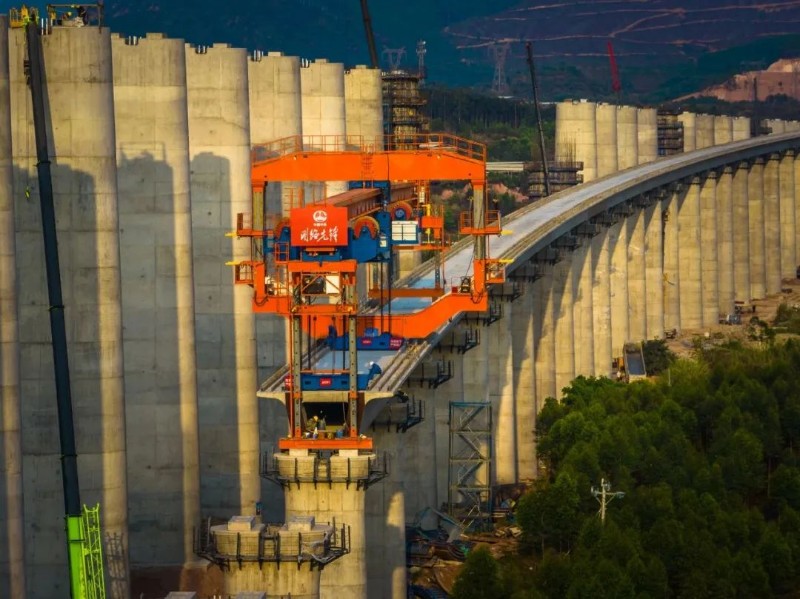
Looking back at the 14th Five-Year Plan period, Guangdong's railway construction achieved outstanding results.
With the opening of these two high-speed rail lines, Guangdong's railway operating mileage has reached 6,433 kilometers, of which high-speed rail operating mileage at 200 km/h and above has reached 3,411 kilometers, a substantial increase compared with the end of the 13th Five-Year Plan period.
Six high-speed railways, including Ganzhou-Shenzhen, Guangzhou-Shanwei, and Meizhou-Longchuan, have been completed and opened to traffic one after another, and 13 new lines, including Zhangzhou-Shantou and Shenzhen-Shanwei, have successively started construction. Guangdong has taken the lead in achieving the goal of "high-speed rail in every city," and the network pattern of coordinated interaction between China's "six vertical and three horizontal" high-speed railway main corridors and regional connecting lines is becoming increasingly clear.
This extensive high-speed rail network has built an economic and living circle featuring "one-hour access between cities in the Pearl River Delta, two-hour interconnection with major cities in Guangdong and Hunan, and six-to-eight-hour connection with the Beijing-Tianjin-Hebei, Yangtze River Delta, and other regions," accelerating the flow of development factors such as capital and technology and achieving deep integration of "hard connectivity," "soft connectivity," and "heart connectivity."
With the network taking shape, internal connectivity is achieved. Through this new Guangzhou-Zhanjiang corridor, western Guangdong can more smoothly access the national high-speed rail network and achieve efficient interconnection with core cities of the Greater Bay Area and even major domestic economic circles such as the Yangtze River Delta and Beijing-Tianjin-Hebei.
This not only opens a high-speed door for western Guangdong to undertake industrial spillover from the Greater Bay Area and receive innovation radiation, but also expands strategic hinterland and growth space for the Greater Bay Area. With the full opening of the Guangzhou-Zhanjiang High-Speed Railway and the Shantou-Shanwei High-Speed Railway, Guangdong Province's railway network will be further improved, the pattern of "two wings flying together" in coordinated regional development will become more prominent, and the province will step onto a new stage through the "power of rail."
Guangdong's high-speed rail construction has not stopped. On the same day, the Guangzhou East Station to Guangzhou Xintang Station fifth and sixth lines of the Guangzhou railway hub (hereinafter referred to as the Guangzhou East to Xintang fifth and sixth lines) officially started construction. The Guangzhou East to Xintang fifth and sixth lines have a total length of about 30 kilometers and a design speed of 200 km/h, passing through Tianhe District, Huangpu District, and Zengcheng District and running parallel to the existing Guangzhou-Shenzhen Railway. The lines can connect hub passenger stations such as Guangzhou East and Xintang, linking the Guangzhou-Shantou High-Speed Railway, the Guangzhou-Shenzhen Railway, the Ganzhou-Shenzhen High-Speed Railway, and other lines, as well as the planned Yongzhou-Qingyuan-Guangzhou Railway and others.
As a key project in Guangzhou's "high-speed rail into the city" strategy, once completed, the lines will enable high-speed rail passengers from eastern Guangdong and the Yangtze River Delta direction to quickly enter downtown Guangzhou, further improving interconnection among the main passenger stations of the Guangzhou hub, optimizing and upgrading the layout of the hub passenger transport system, enhancing the flexibility of hub and network transport, and providing strong support for implementing the national strategy of building the Greater Bay Area, strengthening Guangzhou's positioning as an engine of the Greater Bay Area, and building a world-class transportation hub.
The concentrated opening and commencement of these key railway projects not only brings a successful conclusion to Guangdong's railway construction during the 14th Five-Year Plan period, but also opens a new chapter for coordinated regional development in the new era, vividly demonstrating the solid pace of building a country with strong transportation network taking root in the land of southern Guangdong.
Super-sized Spiral Steel Pipe Launched, Widely Used in Bridge Pile Foundations
下一篇1485 Pile Foundations Completed for the Jingzhou Ring Road Section of the Erguang Expressway

2026-10-14 0 0
2026-09-28 39 0
2026-09-22 10755 0

2026-09-18 11026 0



评论 (0)