Recently, Worker's Daily launched the "Intelligentization in Enterprises" series of reports, providing a panoramic decoding of enterprises' intelligent transformation practices, tracking the new achievements of traditional manufacturing in solving production pain points through intelligent transformation and digital upgrading, focusing on the new vitality brought by the upgrading of emerging industries, and paying attention to the new trends in the intelligent exploration of future industries. The first report takes Zoomlion as a typical case, showcasing the company's high-quality development achievements in leading the industry. The full text follows.
[Intelligentization in Enterprises]
Who Is the Protagonist of the Future Factory?
Reporter Jiang Han
Worker's Daily (November 25, 2025, Page 06)
Walking into the medium and large excavator assembly workshop of the Earthmoving Machinery Park at Zoomlion Smart Industrial City (hereinafter referred to as the assembly workshop), one is greeted by a crisp, technologically appealing industrial gray. On the two frame production lines, one on the left and one on the right, industrial robots operate methodically at their respective stations, and outsiders cannot immediately tell which is the component being assembled and which is the robotic arm performing the assembly task. Workers in dark blue uniforms and yellow safety helmets weave among them, seemingly reduced to supporting roles. There are also scene-stealers—AGVs (automated guided vehicles), some tall and some short, drive past from time to time, transporting various parts to designated stations.
"We can achieve an average of one excavator rolling off the line every 6 minutes." On November 13, Ouyang Shuxun, deputy manager of the Process Department of Zoomlion's Earthmoving Machinery Company, told a Worker's Daily reporter with no small pride that the entire Earthmoving Machinery Park now uses 280 industrial robots and nearly 300 AGVs, with nearly 1,000 workers.
Zoomlion, which mainly researches, develops, and manufactures high-tech equipment such as construction machinery, mining machinery, and agricultural machinery, currently has 26 domestic industrial parks and 13 overseas R&D and manufacturing bases. Zoomlion Smart Industrial City in Changsha, Hunan, is one of them, and it is also the core carrier for Zoomlion's effort to build the future factory. Ouyang Shuxun introduced that, as the "first opening" project of Zoomlion Smart Industrial City, the Earthmoving Machinery Park was the first in the world to achieve full-process intelligent manufacturing of excavators, the first to achieve efficient shared mixed-model production of more than 70 models of excavators, and the first to achieve cross-category collaborative shared linkage among excavators, cranes, concrete pump trucks, and aerial work platforms, forming a new shared manufacturing model for the construction machinery industry characterized by "one driving three."
On November 5, the Ministry of Industry and Information Technology completed the public announcement of the "2025 Pilot-Level Smart Factory Project Cultivation List," with 15 enterprises nationwide selected. Zoomlion was included for its "Excavator Shared Manufacturing Smart Factory" project—that is, the Earthmoving Machinery Park.
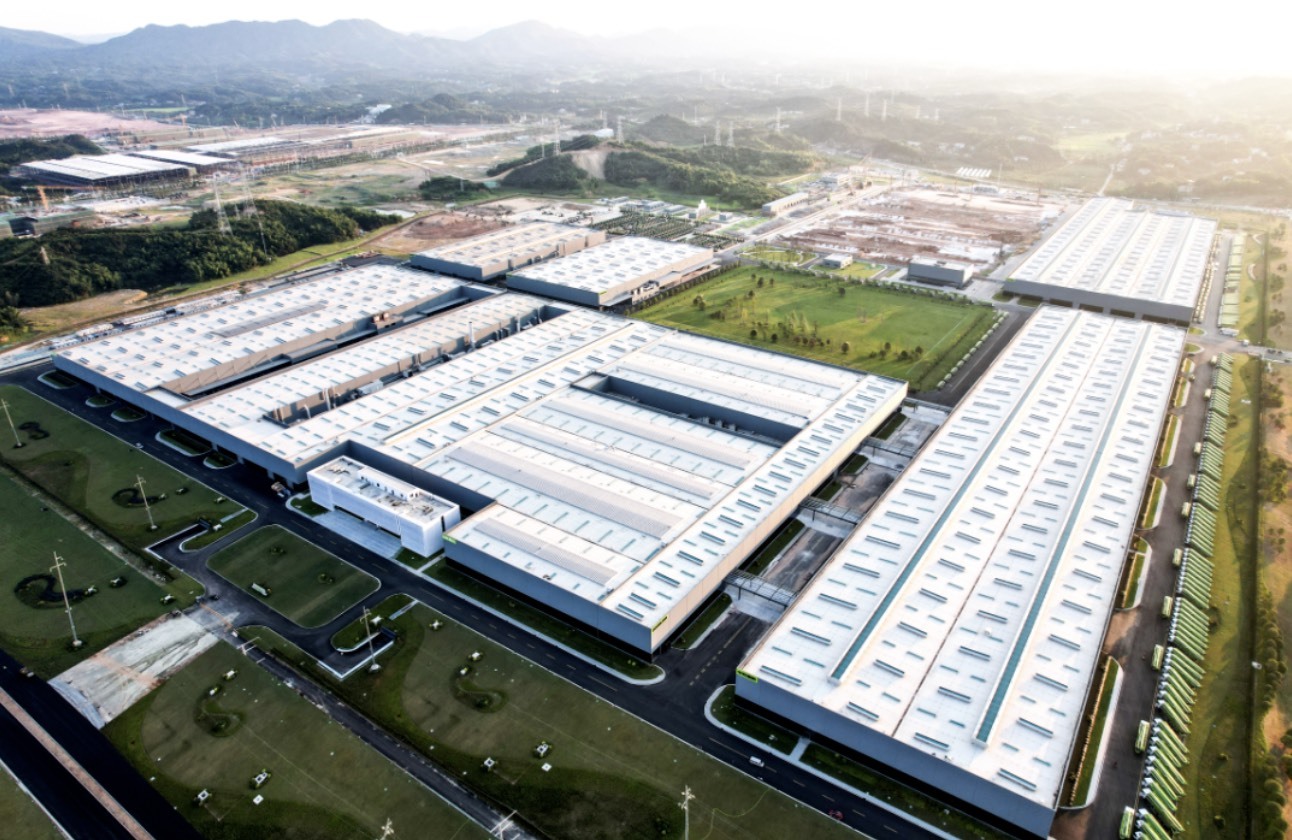
▲Aerial view of the Earthmoving Machinery Park at Zoomlion Smart Industrial City
Like a Symphony Orchestra
The first step in visiting the assembly workshop is to "look up"—after steel plates are assembled into structural components, they are transported to this workshop through overhead logistics, which not only saves manpower but also avoids paint damage caused by manual handling.
Walking forward along the central passage, the upper frame is assembled on the left and the lower frame on the right. "The upper frame involves a lot of wiring harness insertion, so there are more workers; the lower frame mainly involves installing wheels and tightening bolts, most of which is done by robots, with very few tasks requiring workers, such as connecting travel motors and rotary joint pipes, which robots still cannot do," Ouyang Shuxun said.
Lower frame assembly begins at the turning station. In the excavator production process, a lower frame weighs as little as 4 tons and as much as 12 tons. In the past, manual turning was laborious, time-consuming, and very dangerous. Now, with the double-column turning robot, work that previously took 20 minutes can be completed in as little as 3 minutes, and when lowering into position, it can accurately land on the rail transport trolley with millimeter-level precision.
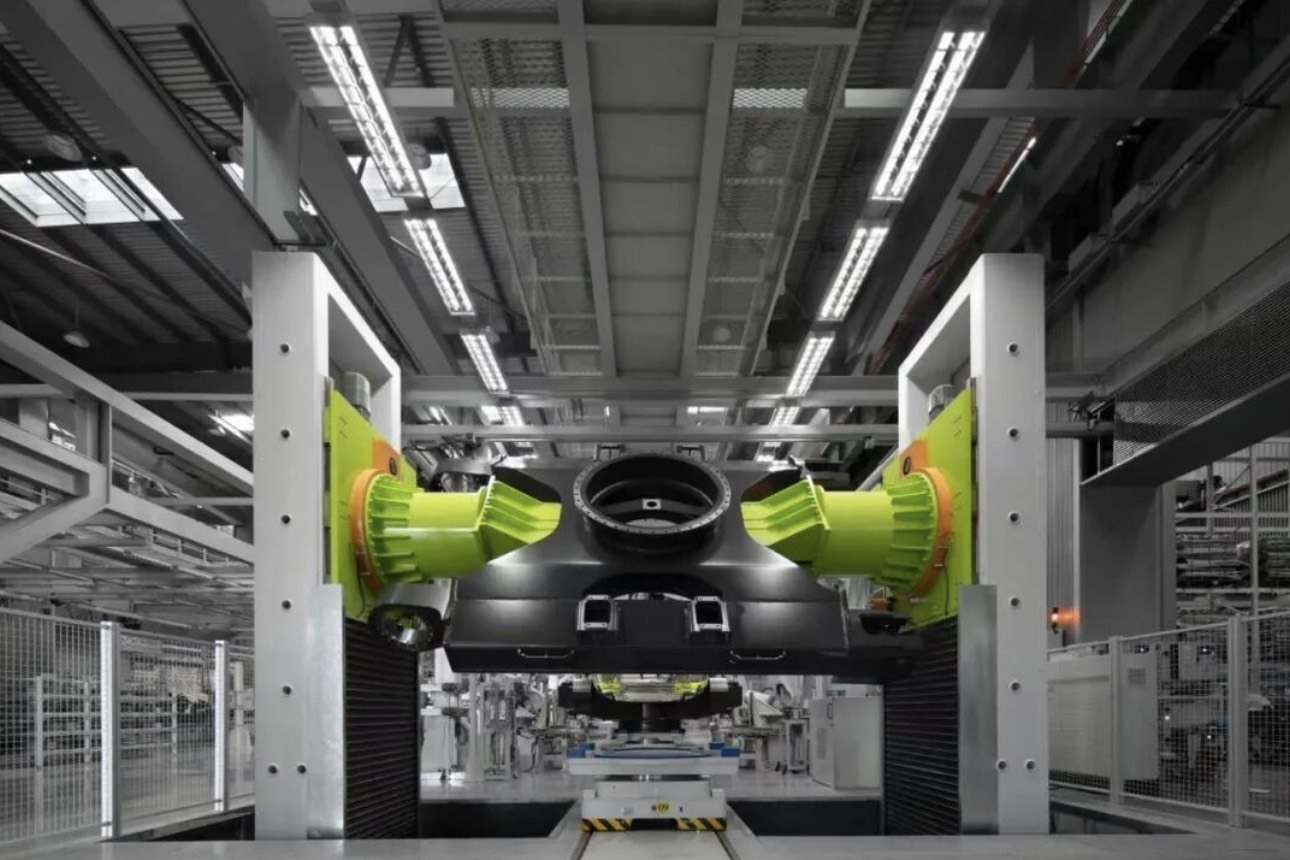
▲Double-column turning robot
At the motor installation station, operator Chen Xiaoqiang presses a button and the robot begins installing screws. "Tightening screws for a long time gives you back pain. Now this kind of dirty and tiring work is basically all done by robots!" Chen Xiaoqiang said with a smile.
Further ahead, a robot is applying adhesive. "In the past, workers held glue guns and walked around the vehicle to apply the adhesive. If it was applied unevenly, it would affect sealing performance. Now the robot applies it more evenly," Ouyang Shuxun said. The whole process used to require two people and 3 minutes; now it takes only one robot and 1 minute.
Next is track installation. "Here we use the only fully automatic track rolling and laying equipment in China, which we designed ourselves," Ouyang Shuxun said.
The joining of the upper frame and lower frame is a key step in this workshop. This process used to be the most time-consuming and labor-intensive. Now intelligent lifting equipment can achieve automatic transport and precise alignment. Complex work that originally required five people can now be completed by only two, and the one-time inspection pass rate can reach 100%.
"The thousands of robots across Zoomlion Smart Industrial City are like a symphony orchestra, collaboratively completing tasks under the unified scheduling of the AI industrial internet platform, the 'orchestra conductor.'" said Zeng Guang, general manager of Zoomlion Zhongke Cloud Valley.
Challenging the Uncharted Territory
Construction of the Earthmoving Machinery Park began on August 30, 2019. The new smart factory was positioned as "globally leading."
"Since we aim to be 'globally leading,' we have to do better than all excavator factories. There is not much to learn from, so we can only innovate and break through, which is quite challenging," Ouyang Shuxun said.
The intelligent transformation unfolded gradually: regarding equipment interoperability, there was a "data island" phenomenon, and an independently developed IoT platform was used to achieve equipment interconnection; digital modeling of key processes was difficult, and digital twin technology was used to optimize process flows; in material units, an intelligent logistics system was used to improve delivery accuracy.
Supply chain collaboration was a difficult problem, as more than 300 supporting enterprises needed synchronous intelligent upgrading. Under the traditional model, the supplier response cycle was as long as 72 hours. By establishing a "1-hour supply chain ecosystem" and deploying a 5G+MEC supply chain collaboration platform, they ultimately compressed emergency order response time from 48 hours to 4 hours, reduced downtime due to material shortages by 82%, and saved more than 50 million yuan in costs annually.
In 2022, the Earthmoving Machinery Park entered volume production. A total of 61 intelligent production lines are planned here, including 4 lights-out lines, achieving a 100% data collection rate for key processes.
Each excavator has more than 4,000 parts and more than 370 manufacturing processes. On the same production line in the Earthmoving Machinery Park, more than 70 different models of excavators can be produced in mixed-model flow, and production capacity can even be shared with other construction machinery products such as cranes and concrete pump trucks.
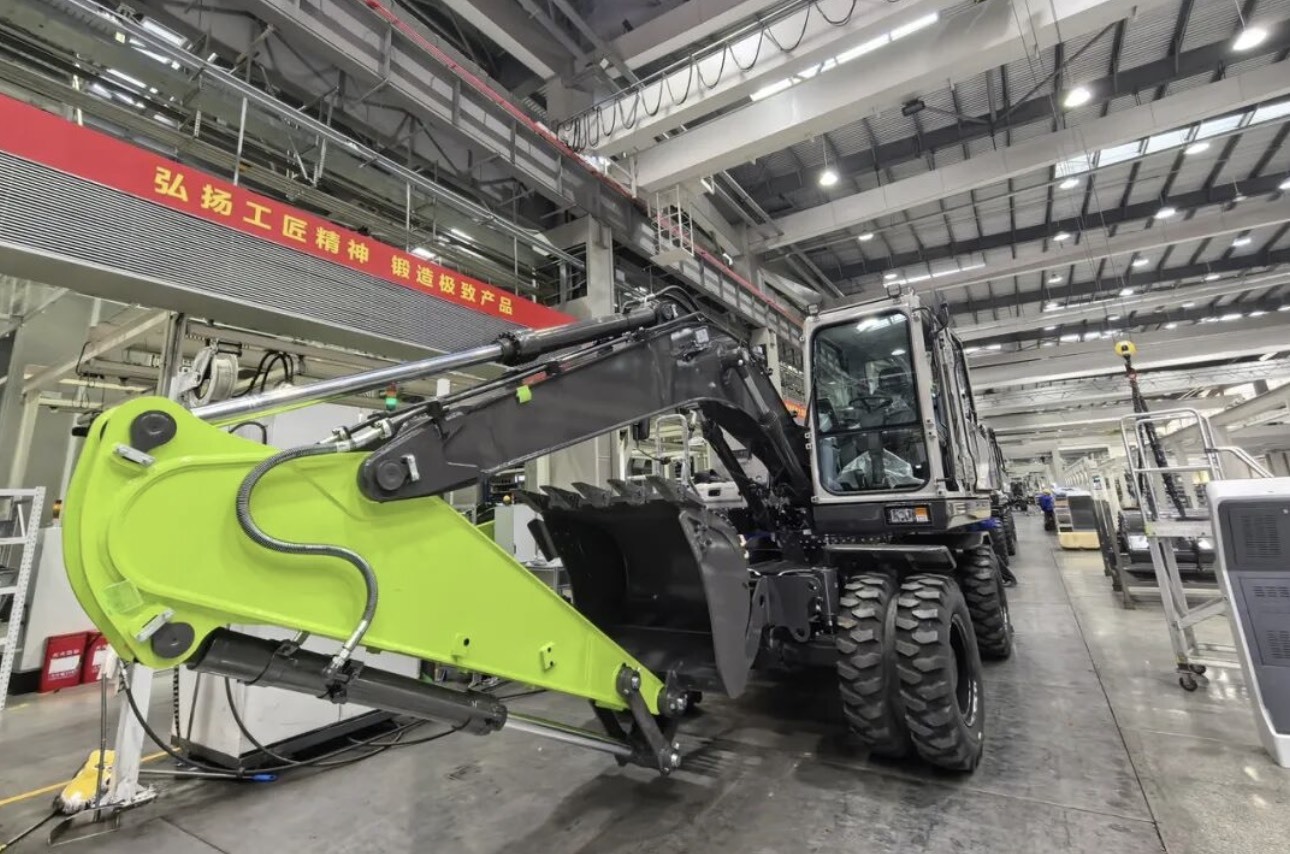
▲A view of Zoomlion's intelligent excavator factory
What Will the Future Look Like?
In one corner of the assembly workshop, a wheeled folding humanoid robot is practicing sorting. More than 30 parts are placed on a table. Following instructions, it picks one up, moves to the side, and places it on a cabinet.
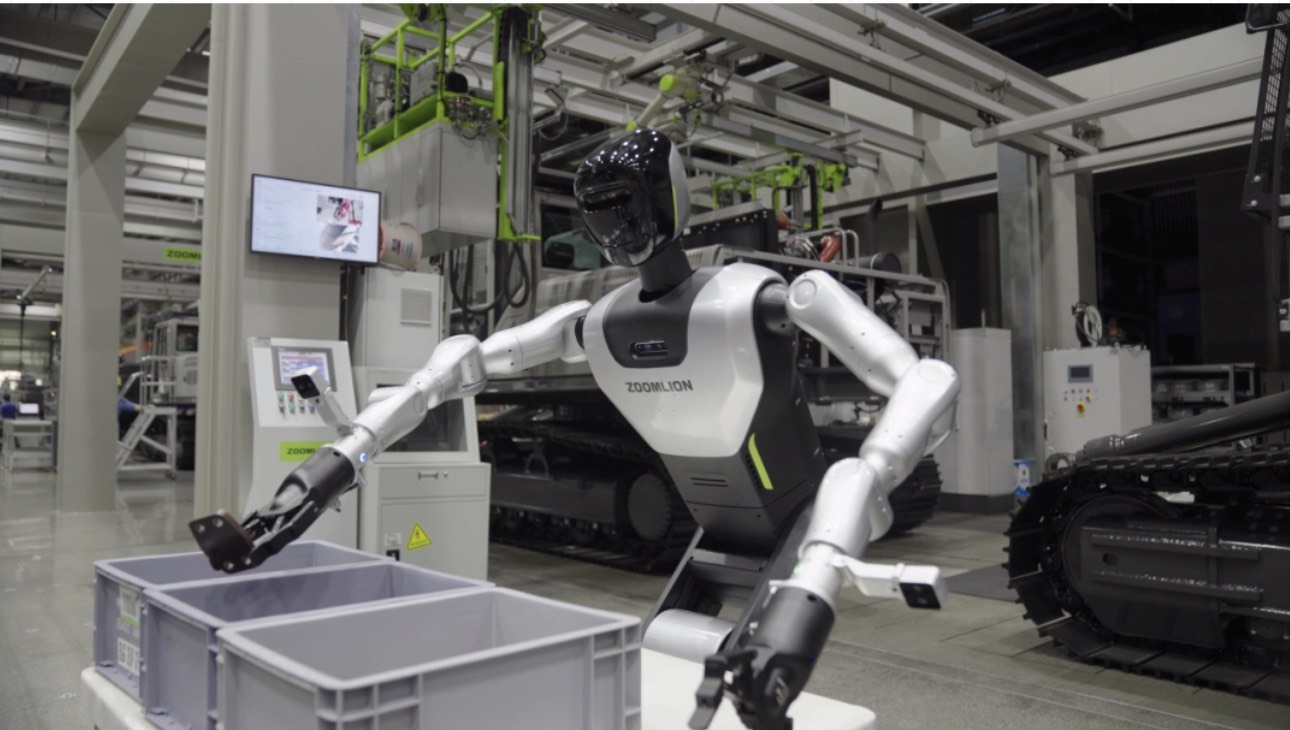
▲The embodied intelligent humanoid robot independently developed by Zoomlion Zhongke Cloud Valley
"We usually check its operation status on the remote operations platform and handle any abnormalities promptly," said algorithm engineer Long Xiaoyu. They collect relevant data and add it to the training set to train the model and continuously iterate. The current sorting accuracy is already about 5% higher than when the company first released its humanoid robot.
Tong Xing, deputy director of the Algorithm Research Institute of the Robot R&D Center at Zhongke Cloud Valley, told the reporter that Zoomlion began developing humanoid robots in 2024 and has built a humanoid robot training ground with hundreds of workstations. In August this year, it began pilot applications in scenarios such as machining, loading, automatic sorting, and pre-assembly.
How did a mechanical equipment manufacturing enterprise come up with the idea of building humanoid robots itself? "This is a natural extension of technological accumulation," Zeng Guang said. Zoomlion has decades of experience in precise control of heavy-duty robotic arms and power system design, which can be quickly transferred to the development of robot joint modules and complete machines.
This is even more a matter of strategic foresight. "The robot industry has broad prospects and can open up a future growth curve for the company and enhance its risk resistance," Zeng Guang said. Promoting intelligent manufacturing through humanoid robots can in turn support Zoomlion's own future factory construction and achieve a more flexible and efficient production model.
In this process, feeding the experience of highly skilled workers to AI is the core of truly integrating robots into high-end manufacturing.
Taking welders as an example, Tong Xing introduced that the first step is to digitize experience: equipping welding masters with data gloves, motion capture devices, high-precision vision cameras, and so on, to break down welding experience into multidimensional, synchronized, and visualized data streams. "Sensors accurately record the angle at which the welding master holds the torch, subtle wrist tremors, and the core parameters selected by the welding master for different plate thicknesses and weld seam types, such as current, voltage, and welding speed."
The next step is model learning and refinement. It is not simply replicating a certain operation of a welding master, but extracting the underlying causal relationships and decision logic from thousands of operations.
Next is simulation verification and iteration. In a virtual environment, the model faces thousands of randomly generated welding scenarios and repeatedly trials and errors there.
Finally, the optimized "welding expert model" is deployed to a physical robot. After the robot actually performs welding tasks, its sensors continue to collect welding results and feed them back, together with the welding master's assessment and the results of the automated quality inspection system, to the cloud-based large model, starting a new round of training and optimization.
"Our plan for the future factory goes far beyond point replacement; it aims to build a new paradigm of intelligent manufacturing that is deeply integrated, highly flexible, and self-evolving," Zeng Guang said.
At present, 92% of the welding work in the Earthmoving Machinery Park can be completed by robots, while the remaining 8% of areas difficult for robots to reach still rely on manual work. As robots evolve, will future workers only need to "press a button"?
Ouyang Shuxun believes that in a highly intelligent factory, workers need to master the ability to use digital tools, such as operating industrial software; possess human-machine collaboration skills, such as robot coordinated programming, AGV exception handling, and intelligent fixture parameter adjustment; and also have data analysis capabilities, such as process parameter optimization, predictive equipment maintenance, and quality traceability.
"We have organized extensive knowledge and skills training and have now built a three-level practical training center (basic skills training, specialized improvement training, and master inheritance training) to provide training at different skill levels," Ouyang Shuxun said.
Zeng Guang described his vision of the future factory this way: robots will perform 7x24 work that is tedious, dangerous, or requires extremely high precision for humans. For example, in an unmanned workshop late at night, robots patrol along predetermined routes, use infrared thermal imagers to detect overheating warnings of equipment, and perform simple preventive maintenance tasks such as lubrication and fastening. Workers will be liberated from repetitive and heavy physical labor, managing several robots at the same time through digital instructions, monitoring robot working status in the control room, handling abnormal situations that the system cannot decide on its own, and continuously training and optimizing robot skills.
So, who do you think will be the protagonist of the future factory?




评论 (0)